
 Gaby
GabyLeading AI scientist Ben Goertzel made this prediction at the Beneficial AGI 2024 summit in Panama.
Ben Goertzel is a Ph.D., mathematician, futurist, and CEO of SingularityNET. In the early 2000s he introduced the term AGI — “Artificial General Intelligence.” Since then, he’s often been called the “father of AGI.”
Goertzel says AI research is entering a phase of exponential growth. New data suggests that AGI — where artificial intelligence becomes as capable as humans in multiple fields, regardless of its training data — is already within reach. This hypothetical milestone in AI development is commonly referred to as the “singularity.”
Goertzel believes the singularity may arrive between 2029 and 2030—but it could even happen earlier, by 2027.
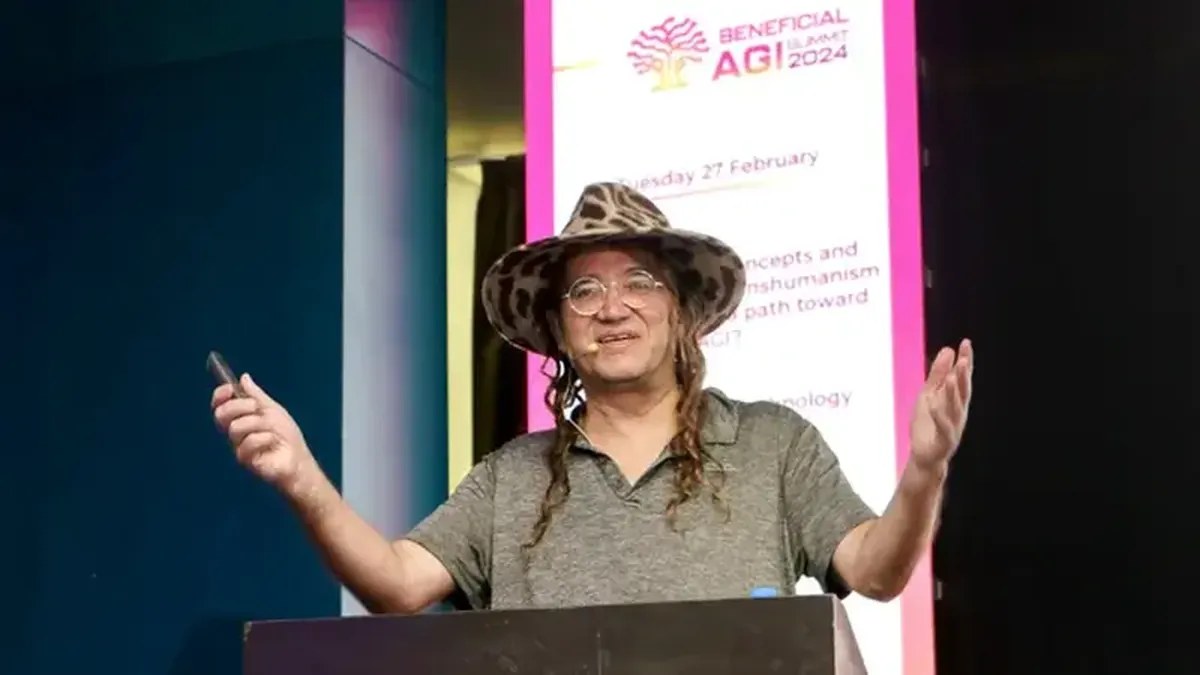
Ben Goertzel, Ph.D.
What Ben Goertzel predicted
The most advanced AI systems today are still considered “narrow AI.” While they can outperform humans in specific tasks — depending on the training data — they cannot surpass overall human intelligence. These AI systems, ranging from machine learning algorithms to large language models (LLMs) like ChatGPT, still lack true reasoning and the kind of contextual understanding a human has.
Goertzel suggested that humanity may create the first version of AGI by 2029 or 2030 — or possibly as soon as 2027. If that version of AI is designed to access and rewrite its own code, it could rapidly evolve into artificial superintelligence. Goertzel defines that as AI possessing the cognitive and computational capacity of all human civilization combined.
He noted that no one has yet created human-level AGI, and no one knows exactly when that will happen. “On the other hand, it’s quite possible we could reach human-level AGI within the next three to eight years,” Goertzel said.
One step away from the singularity
To support his argument, Goertzel pointed to “three lines of converging evidence,” as reported by Live Science. The first is futurist Ray Kurzweil’s modeling in his books “The Singularity Is Near” (2005) and “The Singularity Is Nearer” (2024), in which Kurzweil predicted superintelligence by 2029.
Goertzel also referenced the rapid improvements in LLMs over the past few years, which have revealed AI’s potential to the world. He explained that while LLMs won’t directly produce AGI — because they don’t demonstrate true understanding — they could become components in a broader network of interconnected AI architectures.
The third line of evidence, according to Goertzel, is his work on building an AI infrastructure called OpenCog Hyperon, along with its related software systems and a future AGI programming language named MeTTa.
OpenCog Hyperon is an AI framework that aims to combine established and emerging AI paradigms. Its hypothetical endpoint is a large-scale network of AI systems based on diverse architectures, each modeling a different aspect of human cognition — from content generation to reasoning.
Goertzel, however, acknowledged that he “could be wrong” and that humanity might need “a quantum computer with a million qubits or something along those lines.” He added, “Once you hit human-level AGI, you could have radically superhuman AGI just a few years later — unless it slows down its own progress due to built-in conservatism.”
