
 Gaby
Gaby
One of the biggest challenges for a power grid dominated by clean energy is the unpredictability of certain renewable sources. Sometimes, when solar energy is needed, clouds roll in, or the wind dies down just when wind energy is required.
That’s why energy storage is crucial; engineers and companies are racing to develop effective solutions.
Skyscrapers with a New Purpose
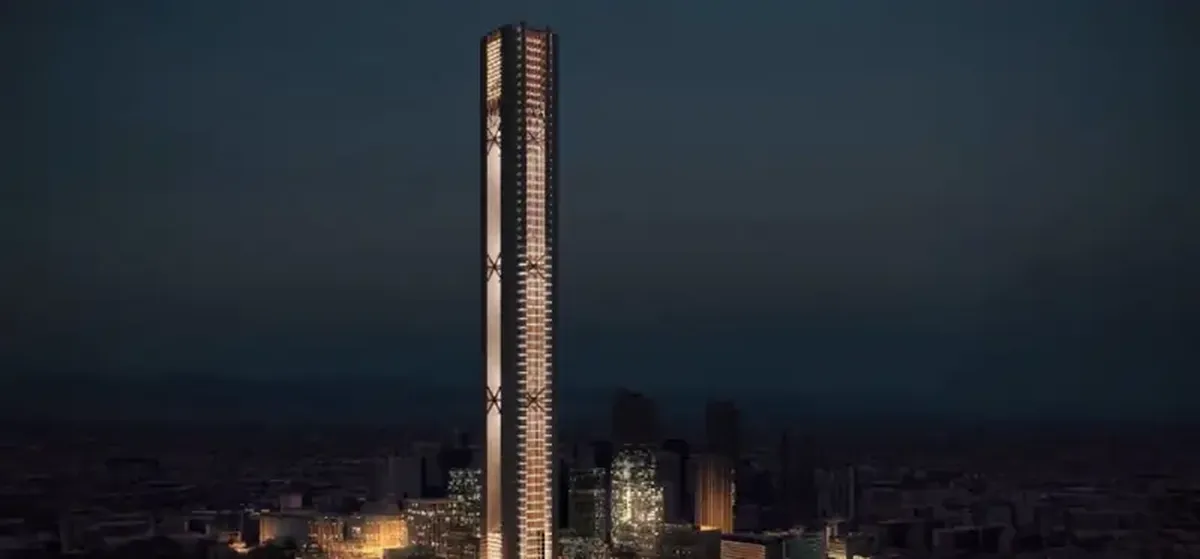
Recently, the architectural and engineering firm Skidmore, Owings & Merrill (SOM), known for designing the world’s tallest building—the Burj Khalifa in Dubai (828 meters)—announced a partnership with Energy Vault, a company that specializes in energy storage. The goal of the collaboration is to develop massive gravitational energy storage systems that would operate inside skyscrapers up to one kilometer tall.
The partners plan to create a skyscraper that will use an electric motor to lift giant blocks when energy demand is low. These blocks will store electricity as “potential” energy. When demand rises, the blocks will descend, releasing energy that will be converted back into electricity, according to CNN.
This method of energy storage could eliminate the need for fossil fuels, noted Bill Baker, a partner and consultant at SOM and the structural engineer for the Burj Khalifa.

Achieving Net Zero Requires New Storage Solutions
According to the International Energy Agency, if the world wants to achieve net-zero emissions by 2050, it must develop grid-scale storage or grid-connected technologies that can store energy and release it when needed.
Lithium-ion batteries, popular in electric vehicles, cannot solve the problem on their own. Primarily because they are not capable of storing energy for long durations.
However, pumped hydroelectric storage can handle long-duration storage and is already widely used to store renewable energy. In a pumped hydro system, a pump moves water from a lower reservoir to an upper reservoir during off-peak hours. When demand spikes, the water flows back through a turbine, generating electricity. But there’s a catch: such systems require hilly terrain and a lot of space.
The above-ground tower from SOM and Energy Vault, which could range from 300 to 1,000 meters in height, will feature hollow shafts resembling elevator wells for moving the blocks. At the same time, there will be space within the tower for residential and commercial areas. The companies are also considering integrating pumped hydro into skyscrapers, where water would be used instead of blocks.
Ultimately, the tower could store several gigawatt-hours of energy. That is enough to power multiple buildings, said Robert Piconi, CEO of Energy Vault.
Energy Vault recently built what it calls the world’s first commercial hydro-gravitational energy storage system that operates without pumps in China. The 150-meter-tall building is designed solely for energy storage (not for living). The system has a capacity of 100 megawatt-hours.
The Taller, the Better?
New opportunities for using renewable energy could help offset the carbon footprint of super-tall buildings. Currently, the building and construction sector accounts for nearly 40 percent of global greenhouse gas emissions.
To tackle this issue, buildings are being fitted with high-performance insulation and low-carbon building materials, among other measures. Some structures are literally going green. For example, Italian architect Stefano Boeri has created towers in Milan covered with trees and shrubs and has developed a similar project for buildings in Dubai.
However, towers are getting taller and more numerous. This trend is driven by demand from rapid urbanization, which pushes people into cities where living space is scarce.
While only 235 buildings over 200 meters tall were constructed worldwide from 1900 to 1999, last year alone saw the completion of 179 skyscrapers of that height or taller.
