
 Gaby
Gaby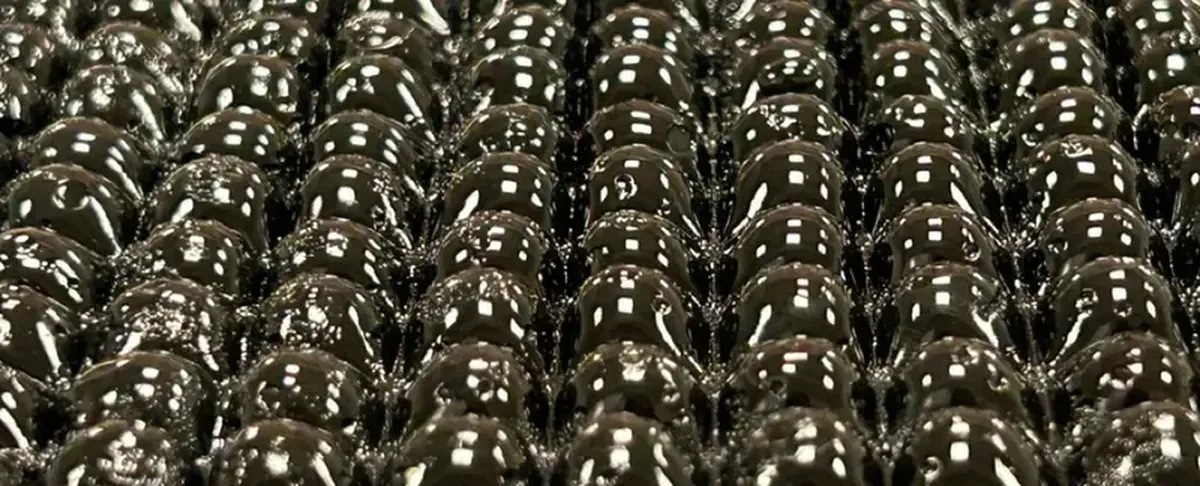
A remarkable black, bubble-covered film could tackle one of the world’s most urgent problems: access to clean drinking water.
As global warming continues, the atmosphere is holding more water. That means we need ways to extract it from the air—even in the driest conditions.
A new passive device collects atmospheric water without any external power. Its inventors tested it in Death Valley, California—one of the driest places on Earth.
In Death Valley, four surrounding mountain ranges push clouds upward, stripping most of their moisture before they reach the parched ground. That makes the area a tough testing ground for water collectors.
The hydrogel film, made from polyvinyl alcohol, lithium chloride (a salt that attracts water), glycerin, and black ink, rose to the challenge.
The team shaped the gel into a bubble-like film to increase surface area for water collection. The team ensured that the material’s microstructure had no pores large enough to let the water-attracting salt escape. Glycerin helped keep the salt contained in the gel.
The gel panel was placed between glass panels with an outer polymer film that aids cooling. During testing, the passive collector—about the size of a window—produced over 50 milliliters of clean drinking water per day. At night, when humidity peaked, it collected more than 160 milliliters, according to Science Alert.

Why Is This Discovery Important?
Globally, 4.5 billion people lack reliable access to safe drinking water. If this device can be scaled and made widely available, it could save countless lives.
Until now, atmospheric water collectors produced very little water—just a few milliliters per day—and often introduced contamination from the materials used in extraction.
As mechanical engineer Chang Liu, the lead author of the study, noted, the technology sets “new standards for daily water production and adaptation to climate change” and represents a significant step “toward practical, scalable, safe, and sustainable water supply solutions for regions facing the greatest water shortages.”
“We are working on the next generation of materials to further enhance its internal properties,” Liu added.
The study’s findings were published in the journal Nature Water.
