
 Gaby
GabyThe Daily Mail reports that the pharaoh of Ancient Egypt’s 18th Dynasty, who ruled roughly from 1332 to 1323 BC, wasn’t a sickly boy-king but a “battle-hardened warrior.”
The long-held image of Tutankhamun as weak and bow-legged was bolstered by some archaeological finds: more than 130 intact walking sticks of various shapes were discovered in his tomb and were thought to have helped the young ruler get around. But several independent experts now challenge the idea that Tutankhamun had chronic ailments.
Biomedical Egyptologist Sofia Aziz says the ornate staffs likely signified royal status and power rather than disability. She argues that the clubfoot other scientists have reported on the mummy may have been produced during mummification—tight wrappings and the application of resin can deform a foot’s shape. She also suggests the middle bone of the left toe went missing during the mummy’s transport, or was taken by someone as a “souvenir.”
Aziz, who has studied more than 50 mummies, summarizes: “On the long, straight leg bones of Tutankhamun there are no signs of the ‘stress’ marks you typically see on the bones of someone who limped throughout their life.”
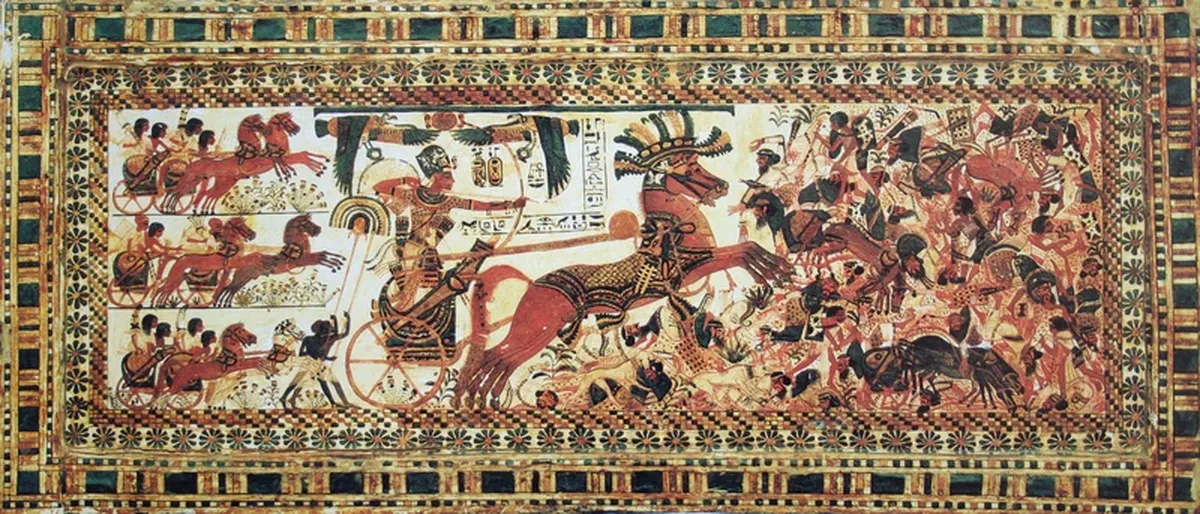
Tutankhamun impresses enemies in a chariot (c. 1327 BC). Wood painting, Cairo Museum.
Dr. Campbell Price, curator of the Egypt section at the Manchester Museum, says the idea of a sickly boy-pharaoh is probably a myth. “Since Howard Carter discovered Tutankhamun’s tomb in 1922, people have pictured the pharaoh as a frail, limping figure,” he says. “But we sympathize with this boy-king because he wasn’t what you’d expect from the golden mask.” Items in the tomb—leather armor and weapons among them—also point to Tutankhamun as a warrior.
Tutankhamun, the son of Akhenaten, became pharaoh at nine or ten. He ruled for about a decade and died at 18 of unknown causes. In November 1922, British archaeologist Howard Carter discovered stairs leading to Tutankhamun’s tomb in the Valley of the Kings. Cataloging the objects in the antechamber alone took months; afterwards Carter opened the burial chamber and found the sarcophagus containing Tutankhamun’s mummy and a trove of treasures.
