
 Gaby
Gaby
What should you know about the trailblazer who wore a radium-filled talisman instead of jewelry, worked for 12 years without protective gear while exposed to ionizing radiation, gave birth to two daughters (a third was stillborn), and ultimately shortened her life through unprotected contact with dangerous elements? You can get a sense of her own conflicted feelings from the founder of a scientific dynasty, who urged those inspired by her story: “I wish women a happy realization in family and pursuits that interest them. I was captivated by exploring the world, but there is no need for such an unnatural life as mine.”
The Incredible Obvious
We are talking about the first scientist in history to win the Nobel Prize twice—the only person to be recognized for achievements in two natural sciences, physics and chemistry. She was the first female Nobel laureate and the mother of a daughter who also won a Nobel Prize. She was the first woman to lecture at a university as a professor at the University of Paris (the Sorbonne) and the first woman member of the French Academy of Medicine, as well as a member of 106 scientific societies. She created the Radium Institutes in Paris and Warsaw and held two dozen honorary degrees and medals from institutions such as the Royal Society of London, the Royal Society of Arts in Great Britain, the National Academy of Sciences in Italy, and the Franklin Institute in the United States. She was a regular participant in international physics congresses and a permanent representative on the League of Nations’ Commission on Intellectual Cooperation. She was a unique researcher who paved the way for medical radiology and discovered the elements radium and polonium—discoveries that demanded personal sacrifice from the experimenter for the progress of humanity.
At the dawn of the 20th century, a career like this was nearly impossible for women. How did this extraordinary person manage to win recognition and become such a singular focus for researchers?
Early Losses
Maria Skłodowska grew up in Warsaw (born November 7, 1867) and by the age of 16 had received the best education available to Polish girls: she graduated from secondary school. She was lucky to be born into a teaching family—her father, Władysław Skłodowski, was the director of a boys’ gymnasium (a graduate of St. Petersburg University who wrote poetry, translated from six languages, and taught mathematics, chemistry, and physics), and her mother, Bronisława Boguska, ran a school for girls. Her mother, however, had to stop working because of tuberculosis, leaving her husband to care for a sick wife and five children.

Władysław Skłodowski and his daughters (from left) Maria, Bronisława, and Helena, 1890.
The situation worsened after a relative’s bankruptcy wiped out the family’s savings—savings her father had invested unwisely—and after he was demoted at work in 1873 over alleged anti-government sentiments. He had to open a boarding house, providing lodging, food, and education for guests. That brought disease into the home: two children fell ill with typhus and the eldest daughter, Zofia, died. In the year Maria was to start school, her mother died of tuberculosis.
Survival Instinct
Those early losses forced the children to grow up quickly: all four distinguished themselves by hard work and independence, graduating with gold medals. While their brother Józef could continue his studies at the medical faculty, girls were not admitted to the University of Warsaw. Maria had to study clandestinely at an illegal “flying university,” where women’s courses constantly changed lecture locations.
To pay for her education and help her sisters and father, Skłodowska worked as a tutor and governess. She worked in the estates of wealthy families, caring for children while teaching younger students. For four years she taught Polish to peasant children and studied at night. As she later wrote, “Curiosity is a survival instinct.”
The girl learned everything life offered: composing poetry, ice skating, rowing, and riding (she rode horses from her youth and drove a carriage). She later took up cycling trips and mountain climbing; for horseback riding, cycling, and climbing in the Tatras, Maria wore pants. She was the first woman to obtain a driver’s license.
To See Paris and…
When her sister Bronisława married a Polish doctor who had emigrated and invited Maria to join them in Paris, Skłodowska moved after a year of thought. Six months later she left her sister’s home and rented a room near the Sorbonne. All she cared about in the Latin Quarter was the university; for that goal she was willing to live in a cold attic where water would freeze in a pitcher overnight, heat tea on an alcohol burner, and eat whatever she could find. The harsh living conditions meant nothing to the passionate student. Even when she fainted from hunger, she felt happy because she could pursue her dreams.

Maria (left) and sister Bronisława, circa 1886.
Maria enrolled at the University of Paris. Unlike Poland, France admitted women to higher education. Still, among 9,000 students there were only 210 women. Women were primarily admitted to study medicine; mathematics, chemistry, and physics—which Skłodowska chose—were studied by only 23 women out of 1,825 students in the Faculty of Natural Sciences in 1891. Only two graduates from that group received degrees, one of them Maria Skłodowska. A top student, she graduated first in her class and had the second-best result among all students. She later returned a previous scholarship to help another diligent student.
A Gift from Fate
She later called her meeting with Pierre Curie “a gift from heaven.” In early 1894 the head of the laboratory at the Municipal School of Industrial Physics and Chemistry gave her a bench for experiments. That new acquaintance eventually became her friend, colleague, and husband.
Pierre came from a family of medical professionals and graduated from the Sorbonne at 16. At 18, he and his brother discovered the piezoelectric effect, and he continued researching ferromagnetic materials—an area Maria also studied. Maria initially investigated the magnetic properties of metals and quickly found common ground with her colleague, who was seven years her senior and interested in magnetism.

Pierre Curie and Maria Skłodowska, 1895.
Pierre taught Maria how to work with the apparatus that would later allow them to study the radiation of elements. After giving her his article “On Symmetries in Physical Phenomena”—a gift without romance—the 35-year-old Curie proposed to 28-year-old Maria, saying it was the only decision he had no doubts about.
Maria appreciated Pierre’s willingness to learn Polish and move to her homeland. She valued the sense of security this calm, self-assured man inspired. After being denied a position at Jagiellonian University in Krakow (no woman was accepted as a lecturer in any department), Skłodowska accepted his proposal.
Daughters and Mothers
In the summer of 1895 Pierre and Maria married in the suburbs of Paris, where Pierre’s parents lived. They registered their marriage with no guests, ceremony, veils, or rings. The bride wore a dark blue suit that she later wore in the laboratory. For their honeymoon in Île-de-France, the couple set off on bicycles they had bought as a wedding gift.
Two years later their daughter Irène was born. The delivery was attended by Pierre’s father, retired doctor Eugène Curie, who then took on much of the child’s care because of the parents’ scientific commitments. Irène continued her parents’ chemical work and became a renowned researcher in physics and chemistry.
In the future she would discover artificial radioactivity with her husband, Frédéric Joliot-Curie, and both received the Nobel Prize like her parents. Irène’s daughter Hélène, also a nuclear physicist, became a professor at the University of Paris, and Pierre’s son became a biochemist at the National Center for Scientific Research—grandchildren of Skłodowska-Curie.

Maria and Pierre Curie with their daughter Irène, circa 1902.
Maria’s next pregnancy ended in August 1903 with a stillborn girl at five months. The tragedy could have been caused by constant doses of radiation—Maria conducted dangerous research even at home—or by an exhausting bicycle trip taken at the wrong time.
The second daughter, Ève, was born in 1904, when Pierre was a professor of physics at the Sorbonne and Maria was running his laboratory. The younger daughter was cared for by governesses and became a journalist, pianist, head of UNICEF in Greece, and her mother’s biographer. Unlike her elder sister, who worked with radioactive materials and died at 58, the younger daughter, distanced from laboratory conditions, lived to be 102.
A Gift to Humanity
Pierre studied the nature of radiation, and Maria became interested after French physicist Henri Becquerel’s experiments with uranium compounds showed rays exposing photographic film. During her experiments Skłodowska-Curie hypothesized that an unknown impurity in uranium pitchblende enhanced the effect. The undiscovered metal she identified was named polonium in honor of her homeland (from the Latin Polonia). In addition to discovering radioactivity phenomena, she chemically isolated radium and polonium and determined their atomic masses.

At the start of their work on radioactivity, Skłodowska and Curie did not know the dangers of radiation. From 1898 to 1902 the couple processed eight tons of uranium ore in a poorly ventilated shed with a leaking roof. To isolate 0.1 grams of radium chloride they spent four years. Maria later wrote that with funds and proper equipment they could have completed the work in a year.
The scientists decided not to patent the discovery of radium and offered it to humanity free of charge. At the time a gram of the substance was worth about $100,000—the most expensive metal in the world at the beginning of the 20th century.
Hostile Matter
By 1904 the price of a gram had risen in France to 750,000 francs. The transformation of radium into a marketable product, produced on an industrial scale, was driven by the discovery of radiotherapy. Maria and Pierre proposed using medical radiology to treat skin diseases and cancer after studying radiation’s effects on living tissue. “The epidermis destroyed by radium turns into healthy skin,” Skłodowska-Curie wrote in her diary. Constant contact with radioactive samples left the couple’s hands covered with sores, and they used those observations to advance medical practice. Thus unfolded the unexpected story of radium’s discovery.
“A discovery does not emerge from a scientist’s brain fully formed; it is the result of extensive preliminary work and a series of failures,” Skłodowska-Curie wrote. “The life of a laboratory researcher bears little resemblance to the calm idyll that some imagine. It is years of focused searching and many doubts when you struggle with despair, the world, and yourself. At such times, matter itself seems hostile.”
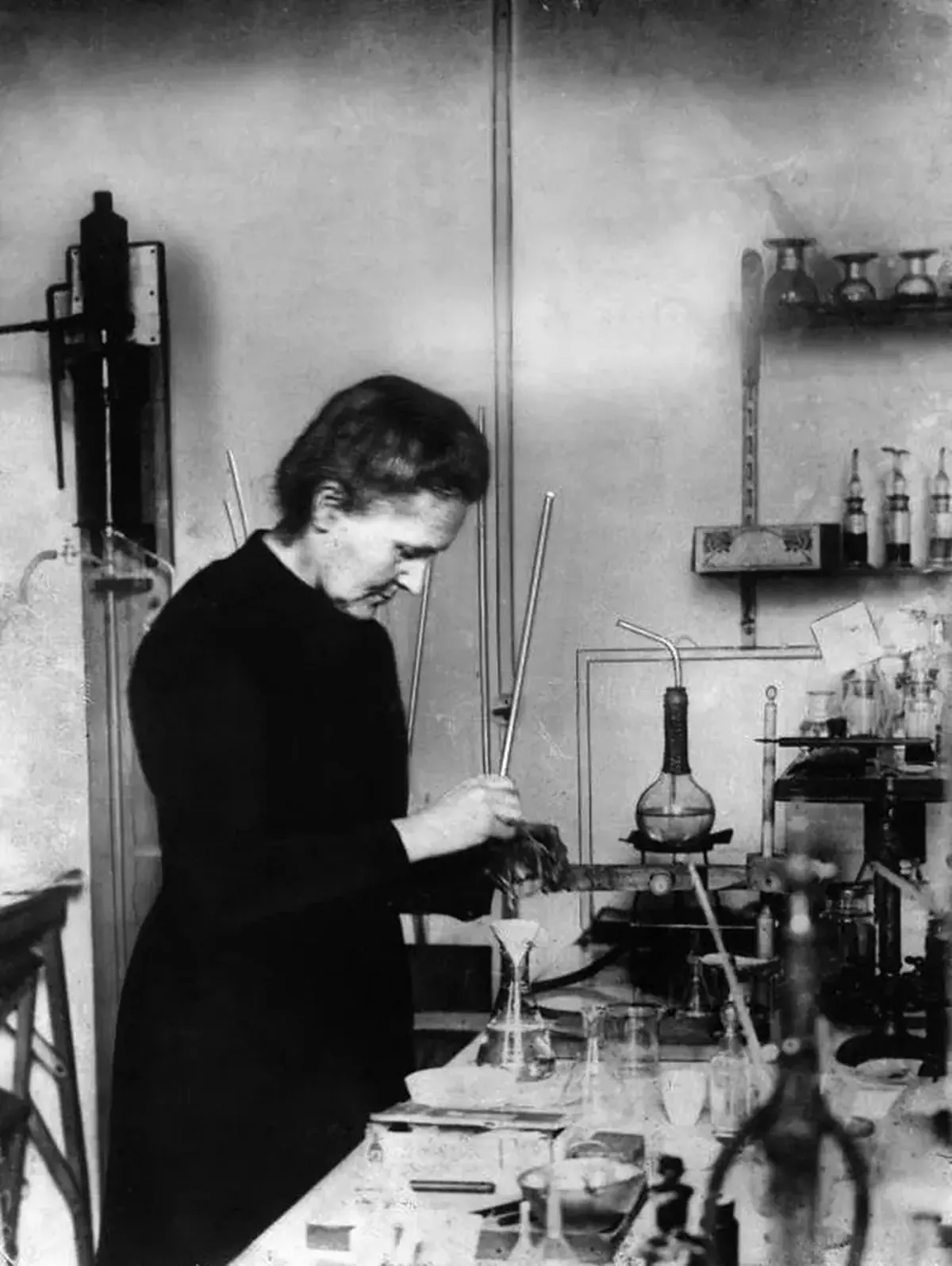
While Pierre suffered pains doctors mistook for rheumatism or neurasthenia, Maria lost weight and developed anemia and later underwent secret cataract surgery—possibly an early sign of radiation sickness. When descendants transferred the Curie couple’s letters, diaries, articles, and books to the National Library in the late 1960s, the archive still posed a danger due to increased radioactivity; after sanitization, all documents were placed in special containers.
Reflecting on her discoveries, Skłodowska-Curie concluded: “Fire burns. But what would we do without it? There is nothing to fear. There is only what needs to be understood.”
The Nature of Calamity
The prize money allowed them to buy new laboratory equipment and install a bath in their home. Otherwise their lifestyle remained ascetic and focused on discoveries. As their daughter Ève later confirmed, few visitors came to them, and the girls were unaccustomed to strangers: Irène feared outsiders and did not greet guests—a trait that stayed with her from childhood.
Valuing time, the researchers could not afford to waste it. “The fatigue from work is intensified by the intrusion of the community,” Maria Curie wrote. “The disruption of our voluntary isolation causes suffering and has the nature of calamity. Along with honor and fame came anxiety into our lives. People interfere with work in every way—it’s all a bustle. Eventually, I gathered the courage to announce that I would not receive anyone.”

Maria confessed to her brother that she did not respond to letters but still had to read them: “Hundreds of requests for autographs and photographs, letters from inventors, spirits, and philosophers, sonnets and poems about radium—even throwing all this away would be a shame. And yesterday, some American asked for permission to name a racehorse after me.”
Albert Einstein always supported her in science, but in life he gave her a blunt assessment: “Madame Curie is very intelligent but as cold as a fish: she lacks emotions—both sad and joyful. She expresses her feelings in only one way: she grumbles if something displeases her.”
Unable to Change
Einstein was only partly right. Beneath her exterior severity, Maria’s diaries reveal a passionate soul. “Constantly, new wonders of nature brought me joy, like a child,” she wrote. She also confessed in her diaries: “People who perceive the world as sensitively as I do, and are powerless to change anything within themselves, must hide this trait of their nature for as long as possible.”
After Pierre’s death on April 19, 1906—he was fatally struck by a horse-drawn carriage while crossing the street—Maria placed a photograph of him in his coffin and sank into a long depression. A new passion eventually pulled her out. Four years later she began an affair with a married former student of her husband. The student even challenged a reporter who published the story to a duel. The duel never happened, and the student returned to his family. Although he ultimately did not leave his wife and children, the scandal could have damaged Maria’s career: after Pierre’s death, Skłodowska took his place at the University of Paris. For the first time a woman became a lecturer and headed a department, but in elections to the French Academy of Sciences she failed to win a majority.

Maria Skłodowska-Curie with her students.
Afterward Maria stopped nominating herself and reportedly declined the Legion of Honor twice, possibly for pacifist reasons. During World War I she funded mobile X-ray units for field hospitals, which helped save soldiers’ limbs from amputation. Skłodowska traveled to the front lines with her elder daughter and taught doctors how to use the new technology.
Maria Curie outlived her husband by 28 years, wrote memoirs about her closest collaborator, and continued her research on radioactivity. In spring 1934 tests showed harmful changes in her blood; on July 4 she died at 66 from anemia caused by ionizing radiation. She is officially recognized as one of the first victims of radiation sickness. In 1995 the remains of the Curie couple were transferred to the Panthéon in Paris as national heroes.
