
 Gaby
Gaby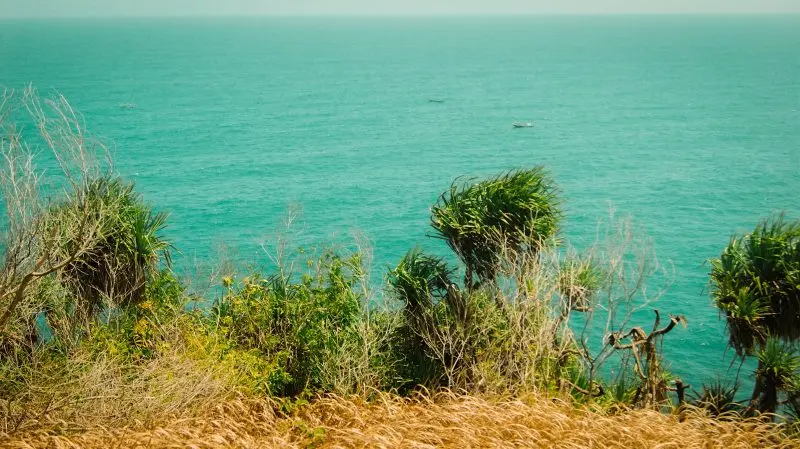
Nearly three-quarters of Earth is ocean, which makes our planet look like a pale blue dot from space. But researchers in Japan published evidence that Earth’s oceans were once green — and that they could change color again. Their work appears in the journal Nature.
The reason the oceans may have looked so different in the distant past has to do with seawater chemistry and the evolution of photosynthesis. The story is recorded in banded iron formations, layers of sedimentary rock laid down during the Archean and Paleoproterozoic eras roughly 3.8 to 1.8 billion years ago. Life then was mostly single-celled microbes living in the seas while the continents were barren gray and brown. Rainwater dissolved iron from continental rocks and rivers carried that iron into the oceans; underwater volcanoes also supplied iron. That iron would play a central role in what came next.
Early Earth’s atmosphere and oceans lacked free oxygen, yet sunlight-harnessing microbes had already evolved. Some microbes used anoxygenic photosynthesis that did not produce oxygen, while others — later cyanobacteria — performed oxygenic photosynthesis and released oxygen. The oxygen released by those later microbes reacted with dissolved iron in seawater, binding to it and turning it into oxidized iron. Only after the ocean’s dissolved iron was largely used up could free oxygen build up in the atmosphere. That transition — a major rise in oxygen levels — is recorded in the alternating dark and rusty-red bands inside banded iron formations.
So how did the seas look green? The authors point out that the waters around the volcanic island of Iwo Jima in Japan sometimes have a green tint caused by oxidized iron, Fe(III). Those green coastal waters host abundant cyanobacteria — commonly called blue-green algae, though they are bacteria, not true algae — which thrive under those conditions. In the Archean, the oceans likely had high concentrations of dissolved ferrous iron, Fe(II), and microbes evolved to live alongside that iron-rich chemistry.
During photosynthesis, cells use pigments — chiefly chlorophyll — to convert CO₂ into organic matter (sugars) using sunlight. Chlorophyll is what makes plants green. Cyanobacteria are unusual because, in addition to chlorophyll, some groups have accessory pigments called phycobilins (for example, PEB). The researchers report that modern cyanobacteria engineered to possess PEB outperform others in green-tinted water. Chlorophyll works well under the broad white light we get today, while phycobilins seem better suited to green-light conditions.
Before oxygen accumulated, the oceans contained dissolved reduced iron that stayed in solution without oxygen. As oxygen-producing photosynthesis spread during the Archean, that oxygen oxidized the dissolved iron, producing particles of oxidized iron that tinted surface waters green. Computer models in the study support the idea that oxygen release and a high concentration of oxidized iron particles could have given ancient oceans a green surface color. Once most of the oceanic iron was oxidized, free O₂ began to appear in both the oceans and the atmosphere. One implication the authors note is that a pale green dot seen around another star could indicate early photosynthetic life.
Those changes didn’t happen overnight. The Archean lasted about 1.5 billion years — more than half of Earth’s history — so ocean color probably shifted slowly and may have fluctuated. That long span could explain why cyanobacteria developed both chlorophyll and phycobilin pigments: using both green and white light would have been an evolutionary advantage in variable light and chemistry.
Could the oceans change color again? The paper argues that ocean color tracks water chemistry and the life that lives there. If sulfur became abundant — for example during intense volcanic activity with low atmospheric oxygen — purple sulfur bacteria could dominate and give coastal and stratified waters purple or brown hues. As the Sun brightens over geological time, increased evaporation and stronger UV could favor sulfur-based metabolisms in deep, anoxic waters, reducing phytoplankton and making deep blue water rarer.
Ultimately, as the Sun expands and engulfs Earth’s orbit, the oceans will evaporate, the authors write. That won’t happen for a very long time. But on shorter timescales, the researchers conclude, shifts in ocean chemistry and biology make future changes in ocean color inevitable.
