
 Gaby
Gaby
Researchers from Swansea University and the University of Southampton (UK) report that beneath Ethiopia, at the Afar Triple Junction where three tectonic plates meet, magma is pushing up from below the Earth’s crust. From that area, rhythmic sounds can be heard, resembling a pulse.
Here, the continent is slowly tearing apart. This is an early stage in the formation of a new oceanic basin. By collecting chemical signatures from volcanoes around the region, a team led by Emma Watts set out to learn more about the process.
Constant Renewal of the Planet
“We found that the mantle beneath Afar is neither homogeneous nor static. It pulses, and these pulses carry distinct chemical signatures. These ascending pulses of partially molten mantle are directed toward the rift plates above. That changes how we think about the connection between the Earth’s interior and its surface,” said Watts.
The surface of our planet is in a state of constant renewal. Tectonic plates are not fixed forever; they shift, collide, and even slide past one another. The places where they meet are often hot spots of geological change, with intense volcanic activity reshaping the surface from below.
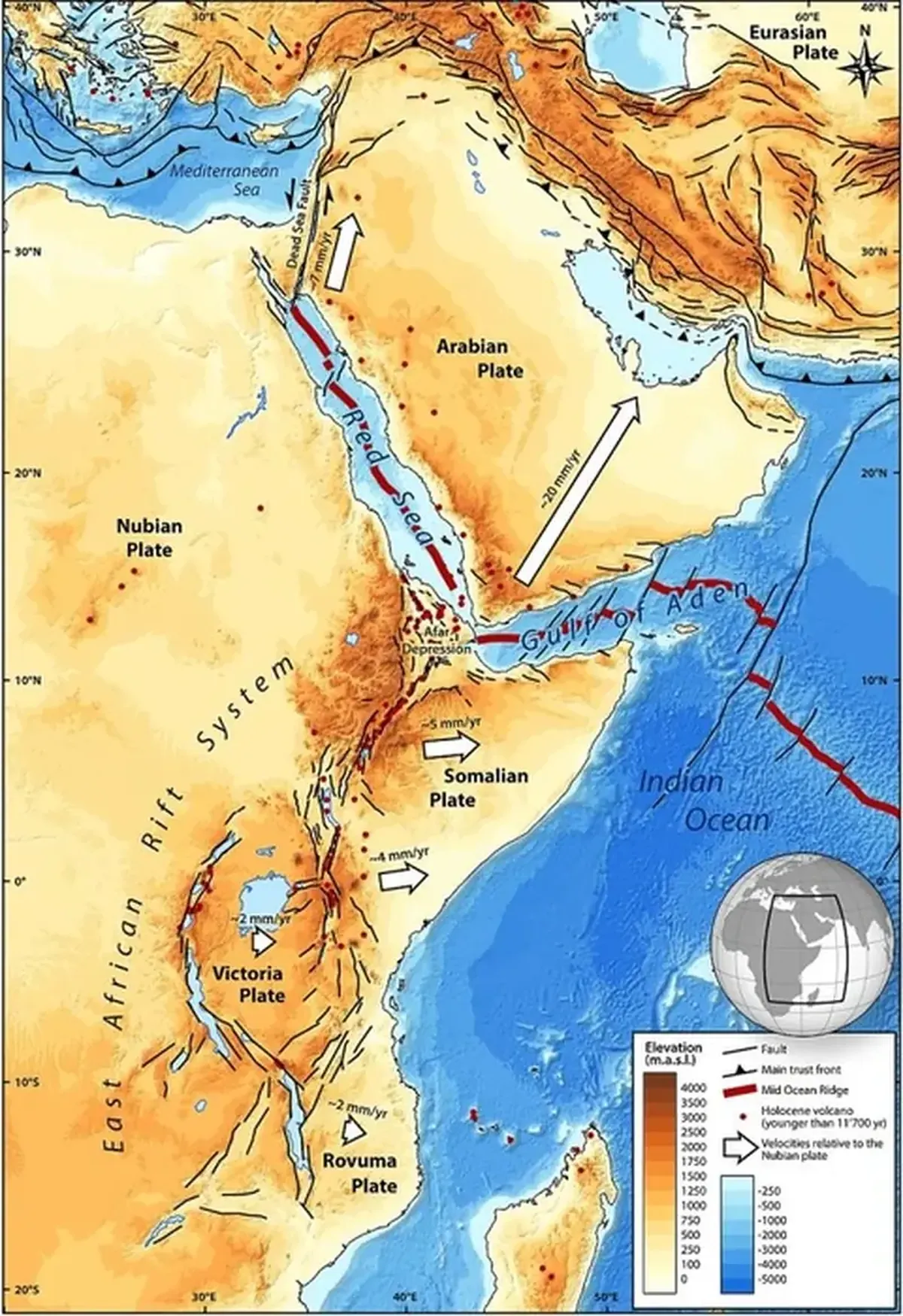
The Afar Junction is where the Arabian, Nubian, and Somali plates converge. Each plate is moving in its own direction, creating a rift. Eventually the crust here will become so thin that the surface will drop below sea level. As a result, a new oceanic basin will form near the Red Sea, according to Science Alert.
Scientists suspect that upwelling mantle material plays a major role in this continental breakup. Our understanding of that process, however, is limited. Researchers cannot simply dig deeper to see what is happening down there, so Watts’ team took another approach: they studied material that volcanoes had ejected from the mantle to the Earth’s surface.
What Did the Scientists Discover?
Geologists collected and analyzed 130 volcanic rock samples from the Afar region and the Main Ethiopian Rift. In addition to chemical analysis, the team ran extensive models to understand what is happening beneath the triple junction.
The results revealed distinct chemical stripes that repeat throughout the rift system. The team interprets these stripes as the product of a single asymmetric plume of material being pushed upward in pulses.
Geologist Tom Gernon, a co-author of the study, said, “The chemical stripes indicate that the plume is pulsing, like a heartbeat. It seems these pulses behave differently depending on the thickness of the plate and the rate at which the plate is breaking apart. In rapidly widening rifts, such as the Red Sea, the pulses spread more efficiently and regularly, like blood flowing through a narrow artery.”
What Can We Take Away?
If the team’s model is correct, it suggests that mantle plumes and deep mantle upwellings may form under the influence of the tectonic plates’ dynamics. That insight could guide future research into the processes that continually reshape our planet.
“We found that the evolution of deep mantle plumes is closely linked to the movement of the plates above them. This has major implications for how we interpret surface volcanism, seismic activity, and continental breakup,” said co-author Derek Keir.
He added that the research shows deep mantle plumes can flow beneath tectonic plates and focus volcanic activity where the plate is thinnest. Future studies should investigate how, and at what speed, the mantle moves beneath the plates.
The results of the study were published in the journal Nature Geoscience.
