
 Gaby
GabyAlexandria, the city where Cleopatra was born, is now at risk of disappearing beneath the sea. A new study finds that rising sea levels driven by climate change are causing the ancient port to sink. An international team of researchers reports that buildings in the 2,300-year-old city are collapsing in large numbers. The city, once home to two wonders of the ancient world—the Great Library and the Lighthouse of Alexandria—is slowly vanishing. In the last decade, the number of building collapses has jumped from about one per year to roughly 40, as saltwater increasingly seeps under foundations. Over the past 20 years, coastal erosion has destroyed 280 structures, with another 7,000 at risk of collapse, according to the Daily Mail.
Sara Fouad, a landscape architect at the Technical University of Munich and the lead author of the study, said, “For centuries, the structures of Alexandria were examples of resilient engineering, enduring earthquakes, storm surges, tsunamis, and much more. However, the rising sea levels and intensified storms caused by climate change have destroyed what took millennia to create.”
What did the scientists discover? Founded by Alexander the Great in 331 B.C., Alexandria was once the largest city on Earth and one of the most important centers of the ancient world. Known as the “Bride of the Mediterranean,” its coastal location made it a vital hub for trade and shipping between the Middle East and Europe. But the same proximity to the sea that drove Alexandria’s growth now threatens to obliterate much of the city.
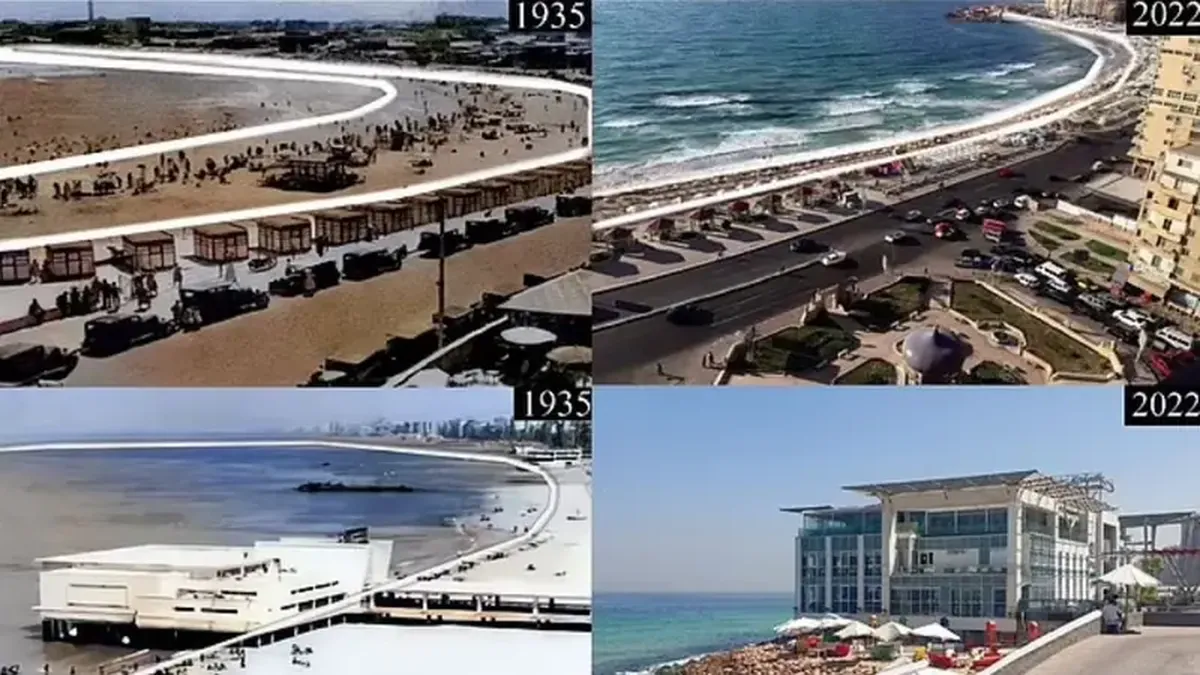
As greenhouse gases build up in the atmosphere, the planet warms and ocean temperatures rise. Warm water expands, and melting glaciers add freshwater—together pushing global sea levels higher. The authors of the new study combined satellite imagery with historical maps to track how quickly the city’s coastline has eroded since the 1880s. They found that in recent decades Alexandria’s shoreline has shifted inland by dozens of meters, with some areas retreating as much as 3.6 meters per year.
“We are witnessing the gradual disappearance of historic coastal cities, and Alexandria is sounding the alarm. What once seemed like distant climate risks has now become a reality,” said co-author Dr. Essam Heggy from the University of Southern California. He added that sea-level rise does not need to be dramatic to cause catastrophic damage. “Our research challenges the common misconception that we should only be concerned when sea levels rise by a meter.” Even a few centimeters of sea-level rise increase the chance of flooding and allow saltwater to penetrate deeper into coastal cities. That saltwater seeps under building foundations and undermines structures long before they meet the sea.
Professor Ibrahim Saleh, a soil scientist at Alexandria University and a co-author of the study, said, “Our isotopic analysis showed that buildings are collapsing from the bottom up, as seawater infiltration erodes foundations and weakens the soil.” The team warns that these threats are not unique to Alexandria; coastal cities worldwide face similar risks. To address the problem, researchers propose several options: build sand dunes along the coast, raise buildings, or relocate people from the most vulnerable neighborhoods.
A recent NASA study found that some areas of California are sinking faster than sea levels are rising. According to the National Oceanic and Atmospheric Administration (NOAA), global sea levels have risen 20–23 centimeters since 1880, with about 10 centimeters of that increase occurring since 1993. A study from Nanyang Technological University (NTU) in Singapore predicted that global sea levels could rise by as much as 1.9 meters by 2100 if carbon dioxide emissions keep climbing.
