
 Carlos Solis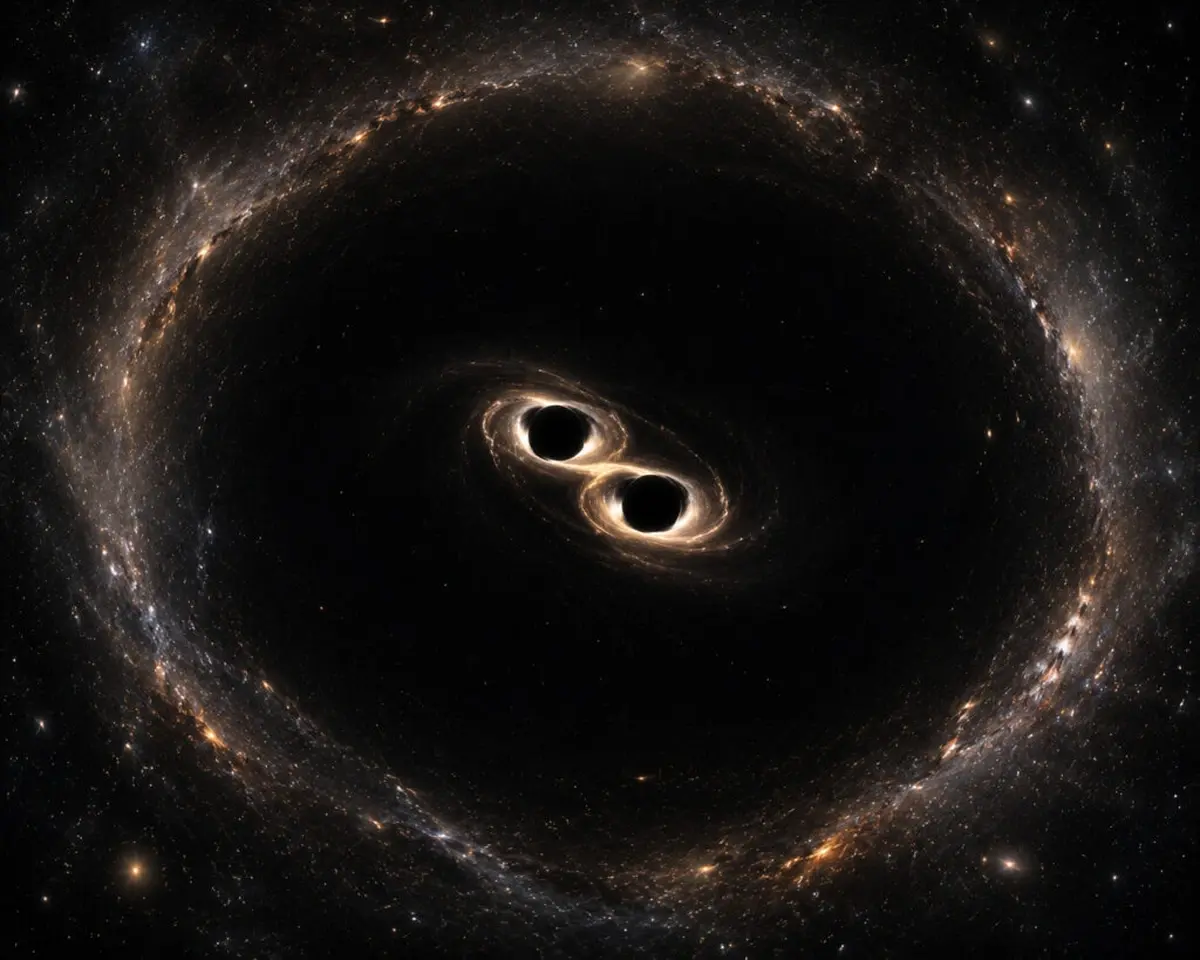
Michael MacDonald, who leads a research team at the Massachusetts Institute of Technology, and his colleagues found that a central cavity in a galaxy is tied to two supermassive black holes orbiting each other. Together they weigh about 60 billion solar masses. As the pair spirals inward, their gravity acts like a giant broom, ejecting billions of stars and planets from the galaxy’s core at high speed.
An unexpected hole at the galaxy’s heart
The story began in 2006, when the Hubble Space Telescope recorded a strange dark patch near the center of one galaxy. Follow-up observations in 2018 showed the same feature, and astronomers again suspected dust. Webb’s infrared instruments let the team look “behind the dust” and confirm that the region is genuinely empty.
A bright infrared point on the western edge of the cavity provided a crucial clue: it looked like an active, accreting nucleus. The MUSE spectrograph on the VLT revealed two kinematically distinct active galactic nuclei (AGN) on opposite sides of the void. The team then analyzed the galaxy’s larger-scale brightness profile and found a flattened core about 2.2 kiloparsecs across—roughly 7,000 light years. Cores this large and flat often indicate ultramassive black holes.
The team’s favored explanation is that the two orbiting supermassive black holes repeatedly shove stars onto dangerous paths. During those gravitational encounters, stars and planets pick up enough energy to escape the central region. Over hundreds of millions of years, that process can clear out the core and create a noticeable cavity. From the shape and size of the flattened core, the researchers estimate that one central black hole is roughly 50 billion solar masses, and the second brings the combined total to about 60 billion.
Why the discovery matters
- These black holes rank among the largest known. Stellar black holes typically weigh between 5 and 100 solar masses, while supermassive black holes in galaxy centers can reach tens of billions of solar masses. The black holes in Abell 402 sit at the extreme end—around 50 to 60 billion solar masses—and their merger would be a colossally energetic event.
- The finding shows the value of a multi-pronged observational approach. Hubble flagged the anomaly, Webb confirmed it wasn’t dust, and VLT spectroscopy revealed the dynamics and the presence of two active nuclei.
- The research sheds light on the “last parsec” puzzle—the question of how giant black-hole pairs lose enough energy to merge. In Abell 402, the team estimates that three-body ejections of stars efficiently shrink the binary during an early, high-energy stage that lasts about 40 million years. In astronomical terms, that’s a blink, which helps explain why we see similar signatures in only roughly 0.5% of massive galaxies.
This article is based on reporting from ZME Science
