
 Gaby
Gaby
Professor Joseph Wegner, an Egyptologist at the University of Pennsylvania who leads the excavations, says tombs of pharaohs are now found extremely rarely.
Researchers are unsure which pharaoh is buried here. They believe that ancient tomb raiders damaged the inscription bearing his name on the tomb wall. However, the team hopes this discovery will shed light on a forgotten era of Egyptian history from 1640 to 1540 B.C., when warrior pharaohs fought each other for territory.
“This was an exciting period of upheaval and conflict. It marked the start of a new kingdom and the golden age that produced pharaohs like Tutankhamun and Ramses,” Wegner said.
What else did the team find?
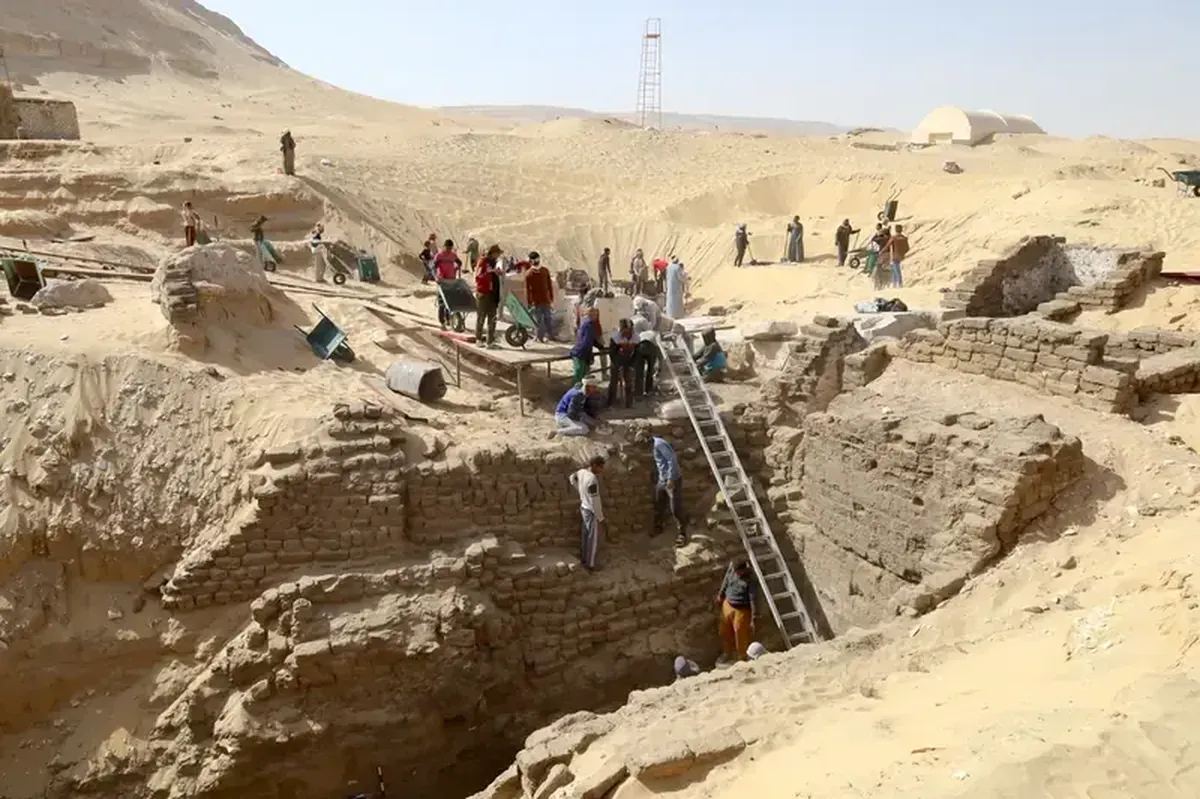
The tomb was buried under seven meters of sand in the necropolis on Mount Anubis. That mountain sits in Abydos, one of the oldest cities of ancient Egypt. It was once ruled by the little-known Abydos dynasty—one of the rival dynasties of the Second Intermediate Period. Wegner called it “a very mysterious dynasty.”
Today, a large archaeological site sprawls across the ancient city, as reported by ScienceAlert. In 2014, Wegner’s team discovered a tomb in this area containing the remains of a pharaoh named Seneb Kay. Ancient tomb robbers had removed his body from its original burial site and relocated it to another chamber. When scientists examined the skeleton, they found 22 traumatic injuries on the bones, including marks from a battle axe that had fractured the skull. The team concluded that the pharaoh died in battle.
The walls of Seneb Kay’s tomb were adorned with paintings and hieroglyphs. Later, researchers uncovered seven more undecorated tombs of Abydos kings nearby.

“We thought we’d exhausted all the evidence until we started work at a new site in Abydos last winter. We ended up discovering another tomb, significantly larger than the ones we’d found before,” Wegner said. Like Seneb Kay’s tomb, this one was decorated with paintings. However, the hieroglyphic inscription with the pharaoh’s name was likely damaged by robbers.
In the tomb, archaeologists found a series of chambers with vaulted brick ceilings about five meters high. “It was a large, incredible structure,” Wegner said. He added that the tomb’s size might have attracted antiquities hunters to the site.
Scientists believe this pharaoh was likely a predecessor of Seneb Kay. The excavation leader said he knows of two Abydos pharaohs whose tombs have yet to be found: Senayb and Pentjeni. One of them could be connected to this tomb.
The team hopes to find clues to the pharaoh’s identity by excavating the surrounding area. Wegner said there’s still hope: the canopic jar—usually inscribed with the dead ruler’s name and used to hold organs—has not been found.
Joseph Wegner and his colleagues plan to return to the excavation site this summer. They aim to explore a significant area and gather more information about this and other tombs. This archaeological site has revealed far more mysteries than Wegner expected when he began working there in the 1990s.
The excavation leader concluded, “We have come to understand that this is a true royal cemetery, similar to the Valley of the Kings.”
The findings were first reported by Business Insider.
