
 Carlos Solis
Fifty films, eight Oscar nominations, and two wins — one of which the actor who played Vito Corleone famously refused as a political protest — are just a few highlights of Marlon Brando’s career. He was a rebel for his generation and a godlike figure to colleagues and followers. Dubbed the “Actor of the 20th Century” by Time, critics said Brando split American cinema into a before and after the way Picasso did painting, Hemingway did literature, and Sinatra did pop music.

Why Marlon Brando Became a Legend: Method Acting and Emotional Truth
The emotional honesty and spontaneity Brando brought to films like A Streetcar Named Desire and On the Waterfront pushed Hollywood acting in the 1950s to a level of realism it hadn’t seen before. His method—treating acting as improvisation—combined with the image of a cool outsider and had a major influence on cinema and on the actors who followed. Many tried to imitate him on screen (he was among the first to use techniques from the Stanislavski system) and off.
Brando won two Oscars, a Golden Globe, awards at Cannes, and three BAFTAs, and he used his fame for activism, particularly in support of Native American rights.
At the same time, the “symbol of a generation” didn’t idealize himself or his craft; he often treated acting as an easy way to make respectable money. Brando famously said, “If I were offered the same money to mop the studio floors, I’d work as a janitor,” “Don’t look for a link between the size of payment and the scale of talent,” and “Acting is the most foolish profession, where only 1% survive and the rest have to fight for their lives the whole time fate gives them.” He became known as the “king of improvisation” on set not only because he transformed into his characters but because he often refused to memorize lines or even read full scripts.
Even with that disdain for acting’s trappings, Brando’s charisma let him bend roles to fit himself rather than the other way around. Calling the movie star “a man sitting on a sugar throne in a rainstorm,” Brando — blunt and outspoken — was keenly aware of how fragile success in the “dream factory” could be. Over the years, directors grew weary of his difficult personality; he endured breaks from filming, accepted less glamorous parts, and in old age sometimes judged his career and life a failure.
Just as Brando changed acting, he gradually changed himself. The world adored him, but he hated himself. A son who became a murderer and a daughter who committed suicide were not plots from The Godfather but real-life tragedies that led Brando to call his role as a father of eleven children a failure. His three marriages, numerous lovers, former physical vitality, and thirst for life belonged to the past. The great actor and heartthrob spent his later years in isolation on his private tropical island, reached about 140 kg by the 1990s, and insisted that private space was not only his right but an absolute necessity.

His Germanic Roots
Marlon Brando Jr. was born on April 3, 1924, in Omaha, Nebraska. His mother Dorothy (Dody) Pennebaker was a theater actress from a family of dissidents and gold prospectors, and his father Marlon Brando Sr. made a living producing animal feed additives and pesticides. Neighbors early on noted his “Teutonic reserve.” A descendant of a German immigrant who settled in New York state in the early 18th century, Brando Sr. had a harsh, sometimes despotic temperament, and his son often bore the brunt of it. The father’s severe discipline traced back to a childhood trauma: his own mother abandoned him when he was four.
Fatherly hugs were rare gifts for Marlon and his older sisters Jocelyn and Frances; for the most part the children received harsh punishments. Brando later admitted he received no parental praise from early childhood through adolescence, only ridicule, which helped make him a “difficult” child. When he was six, during the Great Depression, his father landed a good job with the Calcium Carbonate corporation and moved the family to a Chicago suburb so the children could attend better schools. His mother did not welcome the move because Evanston had few theaters and offered her little work.
His mother’s drinking and lack of attention meant no one cared consistently for the children. Instead, the one close figure in young Marlon’s life became the housekeeper Ermie, whom his father had hired. Marlon developed a childlike crush on the friendly young woman of Danish–Indonesian background. Ermie once told him she had to travel and promised to return. When she left and did not come back, Marlon “lost his connection to the world and felt completely out of place.” Brando’s rebellious streak became his way of getting the attention he had been denied; he clashed with teachers and fought classmates.
At eleven, his only kindred spirit was his childhood friend Wally Cox; the two watched films together that fascinated Marlon with their stories. Soon Marlon’s parents separated for a time and the children moved again. Dody left Chicago and took the kids to her mother in California. Grandmother Nana was more occupied with work than grandchildren — she worked in Santa Ana as a counselor for the Christian Science church. Marlon’s sisters found their niches in the arts: Frances took to painting and Jocelyn followed their mother into acting. Left to himself at sixteen, Marlon began to excel in sports.

From Rebel to Icon: Marlon Brando’s Career
As a teen Brando won his school’s decathlon and set a record in one-arm push-ups; coaches stopped him at his thousandth repetition, worried he might collapse. When Brando Sr. rejoined the family, they packed up again and in 1938 moved to a small Illinois town of about 3,000. In Libertyville the family rented a farmhouse and kept a cow. Marlon played drums in the school band and often arrived at class in comfortable farm clothes, prompting teachers to ask him not to come to class in his pajamas.
He grew to about 177 cm (around 5’10”) and built his physique, so school productions cast him as gangsters and villains — roles his sisters also pursued in the theater club. The amateur actor loved radio plays, where he learned intonation and voice imitation to play multiple parts in the same broadcast. He easily parodied peers, teachers, and neighbors. But his rule-breaking led to humiliation when a school administrator gave him an IQ test and announced the troublemaker’s low intelligence to the class. As a corrective measure, his father decided to send Marlon to a military academy in Minnesota.
Shattuck-Saint Mary’s in Faribault was a school Brando Sr. had once attended, and young Marlon didn’t resist the choice. He found at least three places there where he felt at home: the reading room (where he memorized several Shakespeare poems), the cinema (where he saw Charlie Chaplin’s The Great Dictator), and the office of his English teacher Earl Wagner. Wagner was impressed by Marlon’s declamation and encouraged him to study acting. Brando’s father, however, could not imagine acting school for his son and called theater a place “for pederasts.” Marlon’s path did not follow his father’s expectations.
After being expelled from the military school, Brando moved to New York and by 1944 was performing with a theater company on Broadway. He landed a part in the play I Remember Mama after doing odd jobs as an usher, elevator operator, and soda vendor. Comparing work options, Brando concluded acting was the most pleasant because “plumbers don’t get applause.” His Broadway work caught the eye of director Elia Kazan, who cast the talented young actor in the film adaptation of A Streetcar Named Desire and opened the door to fame.
Iconic Films: A Streetcar Named Desire and His Triumph in On the Waterfront
From his debut in Elia Kazan’s A Streetcar Named Desire it was clear who Marlon Brando was as an actor. The screen adaptation of Tennessee Williams’s play ranks among the hundred best films in cinema history. The movie took three acting Oscars (four Oscars total), a sign of the film’s top-tier cast; Brando’s scene partner was the legendary Vivien Leigh, who played Blanche DuBois. Two years later his starring role in the 1953 film The Wild One turned him, in a leather jacket astride a motorcycle, into a generation’s icon. Director Laslo Benedek’s film kicked off the biker movie genre.

A Streetcar Named Desire
Brando’s contradictory persona made him a natural fit for that hymn to outsider youth. His realistic performance hypnotized audiences and held them with the character’s ambiguity. A few years later the star won an Academy Award for his role in Kazan’s On the Waterfront. In 1955 Marlon Brando became, at that time, the youngest actor to win an Oscar (he was 30; that record stood for two decades). Kazan described Brando’s technique: “I was struck by the actor’s devilish dual nature when I saw a tough, brutal fellow suddenly show tenderness in a romantic scene.”
Those early films established Brando as one of Hollywood’s finest actors. The psychological realism he mastered, taught by a theater mentor steeped in Stanislavski’s system, became a model for a new generation of screen stars such as Alain Delon, Omar Sharif, Warren Beatty, and Robert De Niro. He accepted awards, high fees, and fan adoration as a matter of course. His childhood psychological wounds were sublimated into roles, which made directors and colleagues willing to overlook Brando’s difficult temperament.
He had bad habits: arriving late on set, not learning lines, and reading dialogue from cue sheets held by assistants. Refusing to be boxed into the rebel typecast, Brando pushed the limits of what an actor could do with each new role. Those experiments did not always pay off. In the 1960s his career faltered for nearly a decade. The western One-Eyed Jacks, which he directed and starred in, flopped, and the drama Mutiny on the Bounty damaged his reputation. Only in 1972 did Brando return to box-office form: he earned a second Oscar and a Golden Globe for The Godfather, and a seventh Oscar nomination followed for Last Tango in Paris.

The Godfather and Last Tango in Paris: Brando’s 1970s Legacy
Bernardo Bertolucci’s Last Tango in Paris became scandalous because of a scene of sexual violence that the actress later said she had not fully consented to. What viewers saw in Last Tango was more than Brando’s improvisation; the film raised allegations of collusion between actor and director that deeply humiliated 19-year-old actress Maria Schneider. Schneider later told the press she experienced such degradation on set that she attempted suicide several times.

Last Tango in Paris
The film devastated Schneider’s career: she lost professional standing and suffered long-term psychological trauma. Depression treatment and drug rehabilitation followed as a result of the production’s attempt to capture a genuine reaction to sexual aggression. Although the rape sequence was staged, Schneider never again worked nude and refused overtly sexual roles. Her public disclosures about the traumatic shoot outraged audiences and sparked criticism of both Brando’s and Bertolucci’s legacies, linking their names with an ethical breach in the film industry. After that role many began to see Brando not only as a symbol of acting excellence but also as an example of abusing power on set.
Brando’s controversial reputation extended even after his triumphant work in The Godfather. No other actor seems so right for the role of Don Corleone, even though producers only agreed to cast Brando after some directorial maneuvering. Studios feared dealing with an unpredictable improviser, and Francis Ford Coppola used anonymous screen tests to win approval for his choice. Brando stuffed cotton in his cheeks, greased his hair, and spoke the part in a low, raspy voice. From the first frames Paramount agreed to cast the unrecognizable actor as the mafia boss.
The 1972 film revived gangster cinema and grossed $268 million at the time. For his starring role in the crime drama based on Mario Puzo’s novel — now a classic and still high on many best-films lists — Brando won his second Oscar. He used that triumph and the global attention to make a political statement. He did not attend the awards ceremony: activist actress Sacheen Littlefeather announced Brando’s refusal of the award in 1973 to protest the mistreatment of Native Americans in society and in the film industry.

The Godfather
A Difficult Personality: On-Set Conflicts and Life Off Camera
Defending Native American rights from the 1950s on was a central element of Brando’s politics; he championed land rights and criticized how Hollywood depicted Native Americans. In the 1960s Brando fought racial discrimination, supported Martin Luther King Jr., and donated generously to civil-rights organizations. He used his fame to defend civil rights and often risked making powerful enemies. Criticizing a history of violence, Brando called the U.S. “a nation of monsters and killers,” a stance that prompted boycotts.
But the rebel often acted on impulse without worrying about consequences. Truman Capote described him: “He sat in front of me with a carelessly amused smile, like a Buddha, but the deity was just an ordinary guy who happily ate candy.” Brando was also a keen radio amateur: Federal Communications Commission records list him, for privacy reasons, as Martin Brando. His personal call signs were KE6PZH and FO5GJ; the latter broadcast from the actor’s private Pacific island near Tahiti. Brando bought the atoll Tetiaroa in French Polynesia in 1966, and since 1999 the island has served as a retreat for his family.
Private Life: Family Battles and the Endless Search for Love
Brando’s private life drew as much attention as his work. His stormy romances became a key part of the legend. During filming of his first major success A Streetcar Named Desire he dated Marilyn Monroe. He later told Monroe he was in love with his A Streetcar co-star Vivien Leigh; Monroe left him and later married playwright Arthur Miller. “My biggest problem is an inability to love deeply,” Brando said. “In relationships I use a long bamboo pole with a loop that I throw over a woman’s neck so she can’t leave and won’t come too close — it’s like catching a snake.”
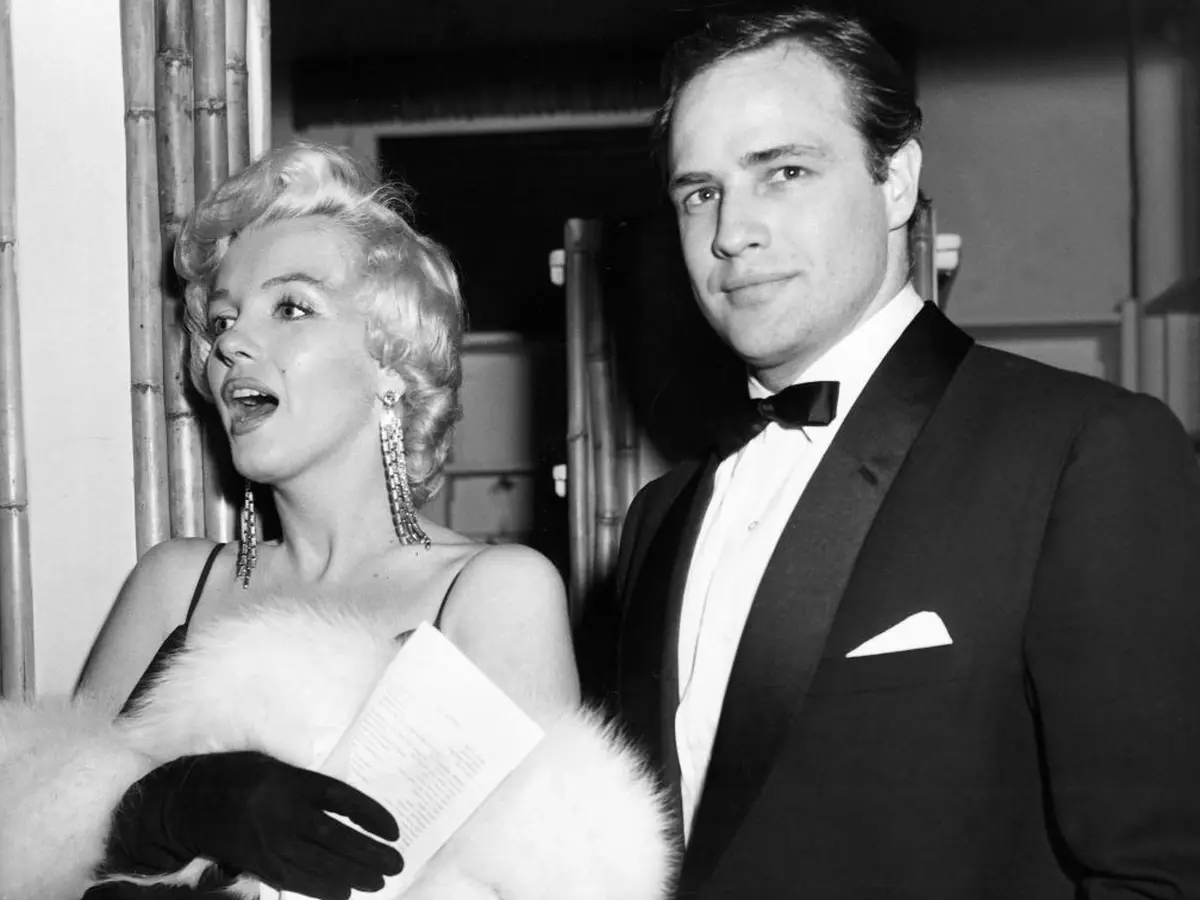
Marilyn Monroe and Marlon Brando
Wives and Children: Tragedies of a Large Clan
Officially Brando married three times, each time to an actress from abroad:
- Anna Kashfi — an Indian actress, Brando’s first wife (marriage lasted two years).
- Movita Castaneda — a Mexican actress, his second wife, seven years his senior.
- Tarita Teriipaia — a Tahitian co-star from Mutiny on the Bounty, his third wife; they were married ten years.
Beyond those marriages Brando had a long relationship with his housekeeper Maria Christina Ruiz. In total Brando officially acknowledged 11 biological children and 3 adopted children:
- Christian Devi — his eldest son with Anna Kashfi; Christian’s fate became the family’s first major tragedy.
- Miko Castillo and Rebecca Brando — children with Movita Castaneda.
- Simon Teihotu and Tarita Cheyenne — children with Tarita Teriipaia.
- Nina Priscilla, Miles Jonathan, and Timothy Gahan — children with Maria Christina Ruiz.
- Stefano (known as Miko), Dylan, and Angelica — children born out of wedlock.
- Petra, Maiima, and Raiatua — children he officially adopted.
Brando’s children experienced dramatic events: a high-profile trial when his son Christian became a murderer and the suicide of his daughter Cheyenne, who could not overcome depression.
Cheyenne’s 1990 death deeply affected Brando and undermined his health.

Marlon Brando’s wives
Final Years and Cause of Death: The End on the Island of Dreams
After that shock Brando gained weight quickly and by the 1990s weighed about 140 kg. The obesity contributed to numerous health problems: he lost much of his sight, suffered heart failure, had breathing difficulties, developed diabetes, and struggled with psychological disorders. He battled mood disorders and faced complicated legal issues. The last twenty years of the great actor’s life were difficult for him.
His troubled private life increasingly attracted attention, though earlier he often didn’t care what people thought. In 1976 Brando publicly acknowledged same-sex encounters and said he would not object if people attributed “a love affair with his best friend Jack Nicholson.” Later biographies detailed Brando’s bisexuality and what they described as a “turbulent erotic life,” listing famous women and men he’d been involved with. In Hollywood Brando’s private life was no secret — rumors linked him with comedians Richard Pryor and Wally Cox. Wally Cox was Brando’s childhood friend; Cox died of a heart attack in 1973 at age 48.
A well-known story says Brando kept Wally Cox’s ashes for 30 years (Cox had been married three times and his widow unsuccessfully tried to reclaim the ashes). Brando willed that his ashes be mixed with Cox’s and scattered together when the time came.
That time came on July 1, 2004: Marlon Brando died at a medical center in Los Angeles at age 80. The cause of death was pulmonary fibrosis complicated by heart and respiratory failure. His body was cremated; his ashes were mixed with Cox’s and scattered over Death Valley in California and partly over Tahiti, per his will. Brando thus remained, in death, close to his dear friend, whom he called “the best part of my life.”
Frequently Asked Questions about Marlon Brando
How many Oscars did Marlon Brando win?
He was nominated for an Oscar eight times and won two statuettes: for On the Waterfront (1954) and The Godfather (1972). He publicly refused the second award.
Who was Marlon Brando’s best friend?
His closest lifelong friend was Wally Cox. According to Brando’s will, their ashes were mixed and scattered together.
How many children did Marlon Brando have?
He officially acknowledged 11 biological children and 3 adopted children, though some sources list even more.
