
 Gaby
GabyFor the past ten months, the Curiosity rover has been studying Gediz Vallis, a channel that cuts through Mount Sharp, a formation that has intrigued scientists since before Curiosity began detailed work there in 2014.
NASA launched Curiosity to Mars on November 26, 2011. The rover landed inside Gale Crater on August 6, 2012. Since then, Curiosity has made numerous discoveries about Martian climate and geology, shedding light on the planet’s history and paving the way for future human exploration.
How the discovery happened
As Curiosity rolled over rocks in the Gediz Vallis channel, one fractured under the rover’s 899-kilogram weight, revealing yellow crystals of elemental sulfur. Sulfates are common on Mars, but elemental (pure) sulfur has never been found there before.
The Gediz Vallis channel is scattered with similar rocks, which suggests pure sulfur may be more abundant on Mars than previously thought.
“Finding a field of rocks with pure sulfur is like finding an oasis in the desert,” said Ashwin Vasavada, a researcher for NASA’s Curiosity project at the Jet Propulsion Laboratory. He added that discovering “strange and unexpected things” is what makes planetary exploration so exciting.
Sulfates can reveal a lot about Mars’ water history and how it changed over time. They form when sulfur, usually in a compound, combines with other minerals in water; when the water evaporates, the minerals are left behind as sulfates.
Pure sulfur, by contrast, forms under very specific conditions that scientists do not think existed in the region where Curiosity made the discovery.
So far, scientists know relatively little about the Red Planet’s geological history. However, finding a large amount of pure sulfur could significantly change our understanding of Mars.
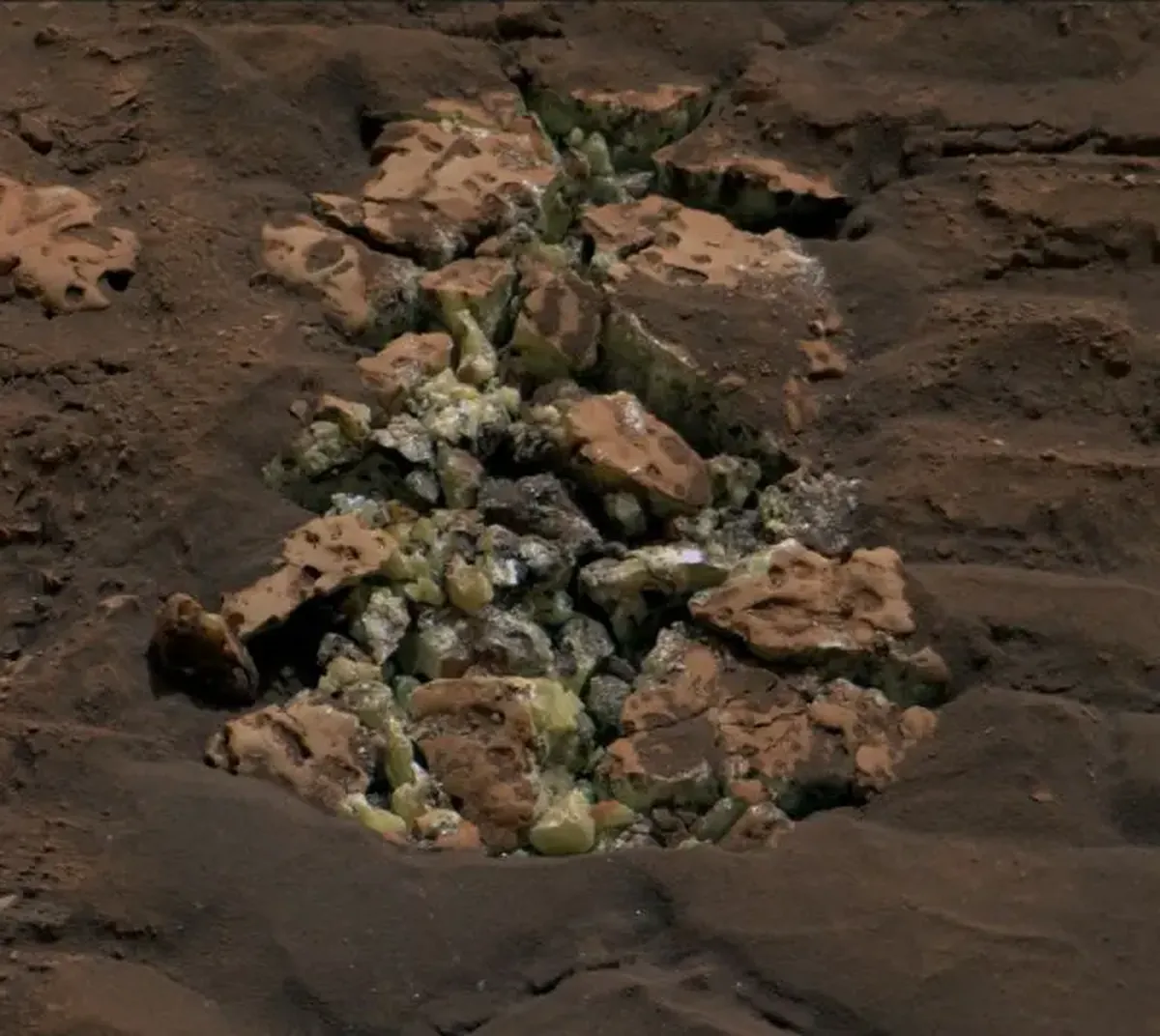
Rock from Mars in which sulfur was found.
Why is this important?
This matters because sulfur is an essential element for life. Organisms typically take it up as sulfates, and sulfur is a component of two amino acids required to build proteins.
Although scientists have known about sulfates on Mars for years, they have not found signs of life there so far. Researchers are continuing the search.
Curiosity’s instruments were able to analyze and identify the sulfur only because the rover happened to crack the rock. ScienceAlert reported that it’s unclear when the team would have found the sulfur otherwise. Now scientists will work to determine how the sulfur got there, spending significant effort on detailed models of Mars’ geological evolution.
Meanwhile, Curiosity will continue gathering data about the ancient waterway of Gediz Vallis, where rocks bear the imprint of a river that flowed billions of years ago.
The rover drilled another hole, collected a powdery sample for chemical analysis, and continued through the channel. Who knows what other surprises await Curiosity around the next bend.
