
 Gaby
Gaby
Thanks to advances in imaging and chemical analysis, researchers can now hunt for surprises in the paint of “The Night Watch” (1642).
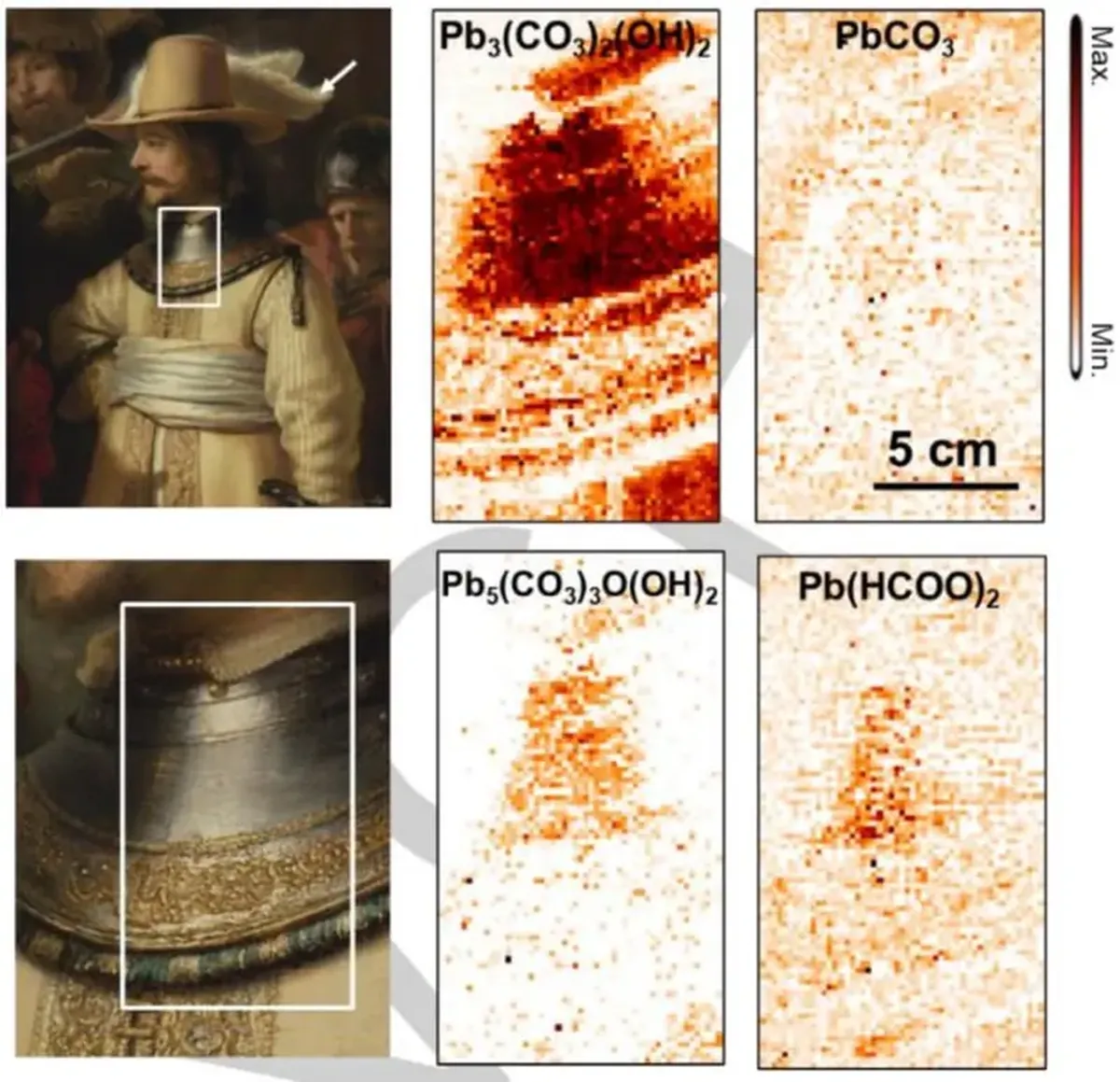
Recently, a team from scientific centers across Europe discovered an unexpected compound—lead formate—while studying the painting’s paint layers.
Shifting Molecules
Finding lead formate on a Dutch Golden Age masterpiece surprised the team.
To analyze the painting’s chemistry, the researchers took tiny paint samples and examined them using new analytical methods, including synchrotron X-ray probing at the European Synchrotron Radiation Facility (ESRF) in France.
As a result, the team identified lead formate (II), Pb(HCOO)₂. Marin Kott from ESRF said they also “mapped the presence of formates on a micrometer scale and traced their formation over time.”
This compound had never been found in historic paintings before and is rare even in modern canvases, Science Alert reported.
Victor Gonzalez, a team member and photochemist at the French National Centre for Scientific Research, believes lead formate may have been overlooked in the past because it breaks down quickly in paintings.
Few Theories So Far
Rembrandt was known for experimenting with materials, techniques, and composition. This find underscores that. “Rembrandt never did what was expected of him,” Rijksmuseum director Taco Dibbits said.
The team suggests Rembrandt mixed lead oxide with warm linseed oil to create the light passages; reactions between that paint and other materials could have produced lead formate. They tried to reproduce that chemistry in the lab, but they don’t rule out that restoration work might have produced the compound. The findings, offering new insight into Rembrandt’s methods, were published in Angewandte Chemie International Edition.
What You Should Know About This Painting
The Night Watch is housed at the Rijksmuseum in Amsterdam.
Measuring 3.63 meters high by 4.37 meters wide, it’s Rembrandt’s largest painting and one of the Rijksmuseum’s biggest works.
The full title of the piece is “The Night Watch of Captain Frans Banning Cocq and Lieutenant Willem van Ruytenburgh.” Despite its name, it shows a daytime scene that has darkened over the centuries.
Rembrandt painted the canvas on commission from the militia company it portrays; the artist was paid 1,600 florins for the work.
The painting was revolutionary because Rembrandt showed the militia in motion, while group portraits of the time were typically static. He included not only militia members but also 16 bystanders, and art historians have long debated what role those figures play.
In 1715, the canvas was trimmed on all sides to fit the Small Hall of the Military Council in the Amsterdam Town Hall. That alteration removed two militia members from the composition.
The painting has survived many ordeals. During World War II it was hidden from Nazi occupiers in bomb shelters, rolled up in a tube.
Vandals have attacked The Night Watch at least three times. Once, a piece was cut from it. Another time it was stabbed with a knife. A third time it was splashed with sulfuric acid; fortunately, the canvas survived and only the varnish layer was damaged.
In 2021, experts used artificial intelligence to reconstruct the painting’s likely original appearance. They used a 17th-century copy by Gerrit Lundens and X-rays of the underlying paint layers to reverse the darkening. The AI reconstruction is also on display at the Rijksmuseum.

