
 Carlos Solis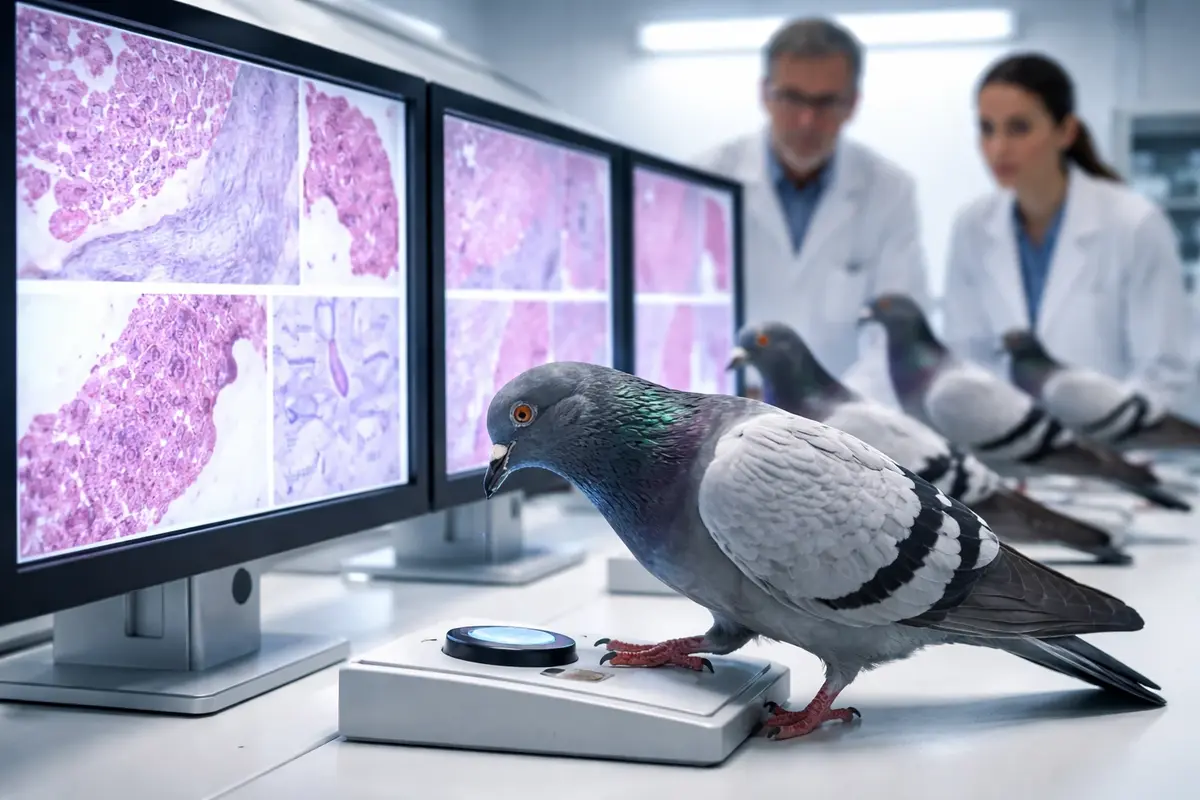
Before AI went mainstream in medicine, researchers found an unexpected helper: the everyday city pigeon. In 2015, researchers trained pigeons to tell apart images of breast tissue — distinguishing benign from malignant samples. After about two weeks of training, individual birds reached about 85% accuracy in separating cancerous and noncancerous areas.
When researchers pooled decisions from several birds, performance improved even more: a group decision by four pigeons reached 99% accuracy in one diagnostic task. That doesn’t mean pigeons will replace doctors, but the result is striking.
How researchers trained them
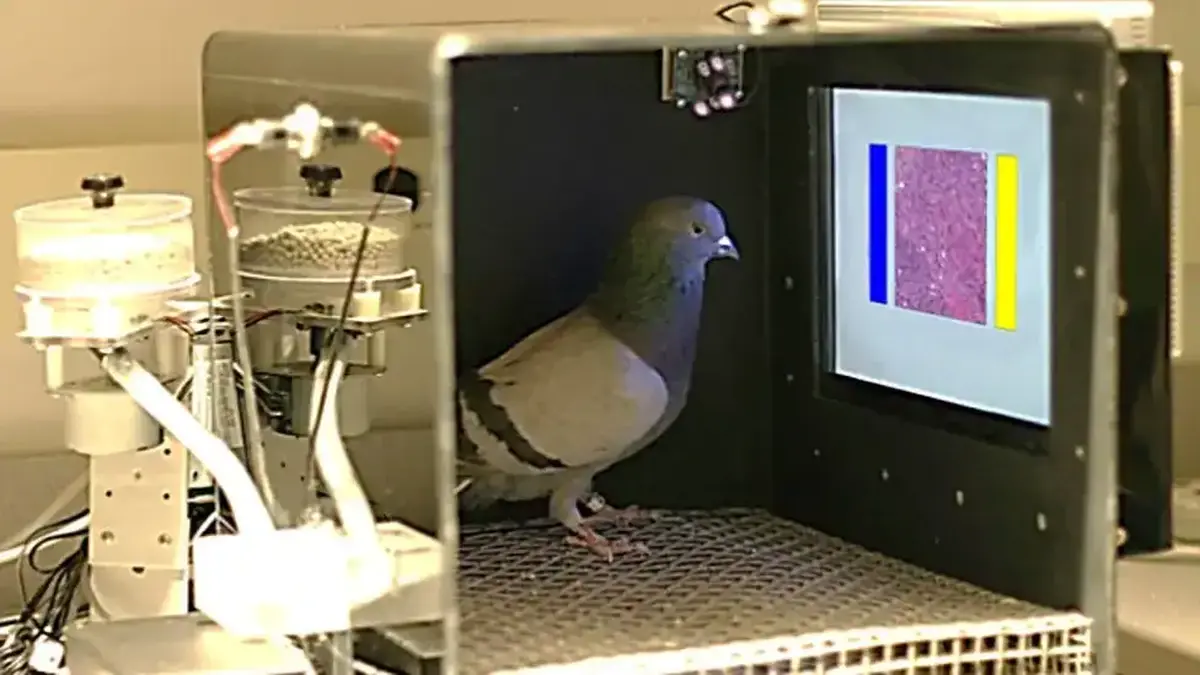
Professor Richard Levenson at the University of California, Davis, and Professor Edward Wasserman at the University of Iowa led the 2015 study. Researchers placed the birds in front of a screen showing digital images of histology slides. Pigeons pecked one button if they judged the tissue benign and another if they judged it malignant. Researchers rewarded correct answers with food pellets.
The birds showed remarkable memory: they could recognize more than 1,800 images, sometimes very similar ones. Crucially, they also learned to recognize new, previously unseen images. The birds picked up visual signs of malignancy, such as darker or densely clustered cellular structures and atypical patterns.
Trained pigeons approached the performance of medical experts on some histology tasks and certain mammography tasks. However, they failed a tougher test that looked for suspicious tumor masses on mammograms. So the successes applied to controlled image samples, and researchers urge caution in interpreting the results.
Why they’re so successful
One hypothesis is that pigeons arrive at the lab already “pretrained” by their natural visual experience. In flight they scan landscapes, fields, roads, roofs, rivers, and repeating textures, and they constantly sort important visual signals from noise. That everyday visual training may help them more quickly spot structural patterns and boundaries on stained histology slides.
To test that idea, researchers in 2024 trained neural networks on a large set of aerial photographs called “BirdsEyeViewNet” and then transferred that training to the same histopathology and mammography tasks used in the bird experiment. The model pretrained on aerial photos performed well on histology images but also failed on the mammographic-mass task, mirroring the pigeons’ strengths and weaknesses. That outcome doesn’t prove the same mechanism operated in live birds, but it strengthens the case for a visual similarity between the two image types.
What this means for diagnostic medicine
The core idea is simple: diagnosis starts with how you see — noticing patterns, separating signal from noise, and recognizing when tissue looks abnormal. The pigeons’ example shows that this skill depends not only on knowledge but also on prior visual experience and the ability to generalize across changes in scale, color, or image quality.
Pigeons pecking buttons are unlikely to replace clinicians, but the research points to ways to improve computer models and medical training. Understanding how eyes — human, animal, or artificial — learn to see disease could help build more accurate tools for detecting pathology.
This story draws on reporting from ZME Science
