
 Carlos Solis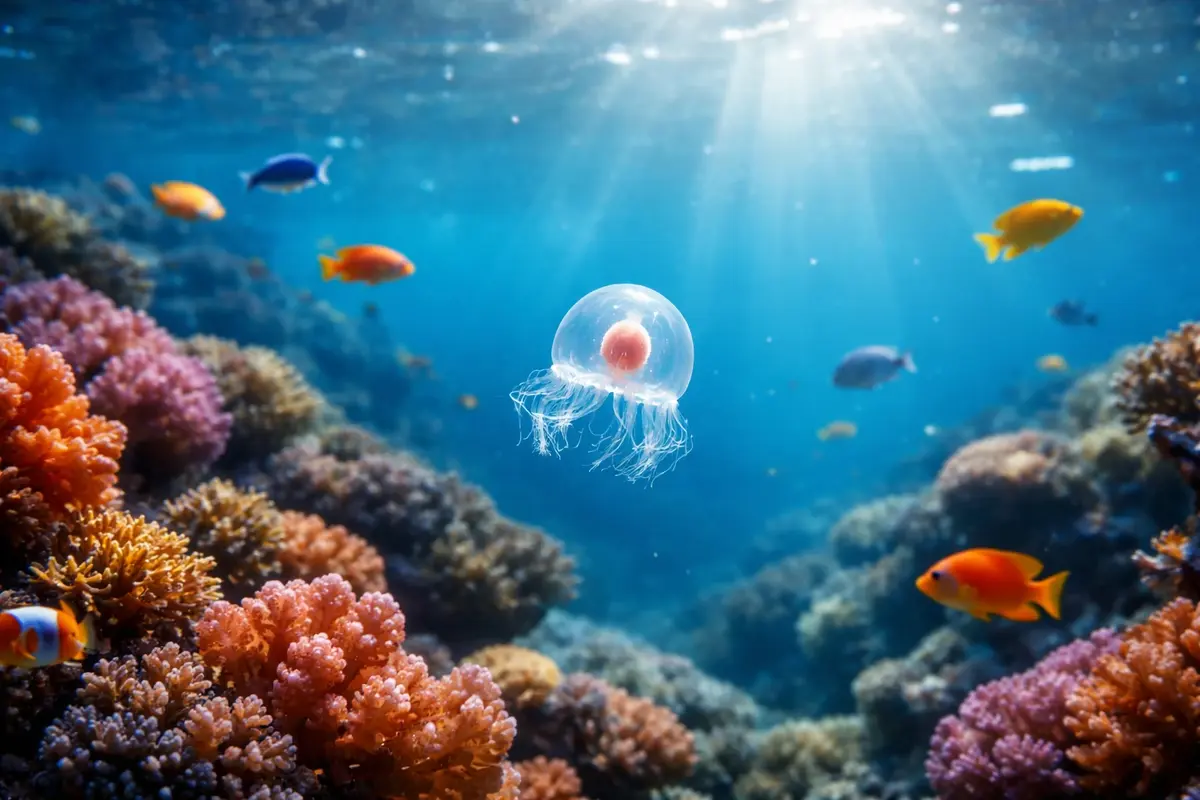
The “immortal” jellyfish, Turritopsis dohrnii, can reset its life cycle after a lethal injury.
About the size of a pea, this little sea creature settles on the seafloor, retracts its tentacles, and transforms into a soft ball. That ball corresponds to the polyp stage, an early phase of the life cycle that Turritopsis can return to in order to produce new individuals. Those new jellyfish separate from the polyp as fully independent creatures and are genetically identical to the parent.
Is this a true “return to infancy”?
One key distinction matters here. When people give birth, a new organism forms when an egg and sperm merge, so a child is not an exact copy of the parent.
A woman’s eggs are present from birth, and an embryo is considered a new organism.
In the jellyfish’s case, new individuals appear without any sperm. So it makes more sense to call them offspring rather than a restored version of the same animal — but those offspring are exact genetic clones.
The parent jellyfish reverts to a stage that can produce offspring, effectively restoring its reproductive youth—similar to reversing menopause. It does this quickly enough to avoid dying.
What researchers found and why it matters
Scientists have studied the jellyfish since its discovery in the 1980s. The reversion to the polyp stage has mostly been observed in captivity, so it’s unclear how often it happens in the wild.
In 2022, Spanish researchers compared Turritopsis dohrnii with related species and found that it expresses certain genes more actively. Those genes are linked to several key processes:
- Genes that increase DNA repair after damage
- Genes that help preserve telomeres, the caps at chromosome ends that shorten with age
- Genes that support stem cells needed for tissue regeneration
Those discoveries provide a biological basis for the idea that aging can be partially rolled back at the cellular level. Whether the same mechanisms could rejuvenate human bodies—or ultimately outsmart death—remains unknown.
Researchers hope to study the jellyfish’s mechanisms to develop new approaches for treating age-related conditions. At this stage, those prospects are subjects of scientific exploration rather than ready-to-use therapies.
Based on BBC Science Focus
