
 Gaby
Gaby
The man often called the father of experimental physics pushed human knowledge forward — but his achievements came with a heavy personal cost. The ruling Church saw his ideas as a threat to the established order and to its spiritual authority. It was a clash between institutional power and a scientist who dared to question received wisdom.

Personal Development
Ironically, the man who would later champion heliocentrism had once planned to become a priest. Educated early at the Vallombrosa monastery, he embraced the principle “measure what is measurable and make measurable what is not,” and as a novice showed a strong appetite for learning. From youth he was one of the best students in his class, but it was his father’s objections that ultimately steered him away from the priesthood.
Galileo Galilei was born on February 15, 1564, in the city of Pisa. He was the eldest of six children; four of his siblings survived to adulthood, two girls and two boys. The Galilei family were impoverished aristocrats whose lineage included a great-great-grandfather, also named Galileo Galilei, who had served as the popularly elected head of the Florentine republic in 1445 and practiced as a physician.
Galileo’s father, Vincenzo Galilei, is recorded as a lutenist and music theorist. Galileo’s younger brother, Michelangelo, also became a lutenist. When the family moved to Florence, the Medici-ruled capital of the Duchy of Tuscany, their children had greater access to the arts and sciences thanks to the Medici tradition of patronage.
From childhood Galileo loved music and drawing and developed both skills to a high level. Florentine artists such as Bronzino and Cigoli consulted him on perspective and composition, and Cigoli later credited Galileo with contributing to his own reputation. Galileo’s writing also revealed literary talent, which widened his scientific interests, sharpened his analytical thinking, and made his arguments more persuasive.
Introduction to Mathematics
At his father’s insistence, in 1581 the 17-year-old Galileo began studying medicine at the University of Pisa, but he quickly became captivated by geometry. In lectures by Ostilio Ricci he discovered mathematics and, while studying ancient philosophy, learned to reason with measurements and assumptions. He earned a reputation as an insatiable debater who valued truth over authority. Even then, some believe he was drawn to Copernican ideas, since astronomy was an active topic during debates over calendar reform.
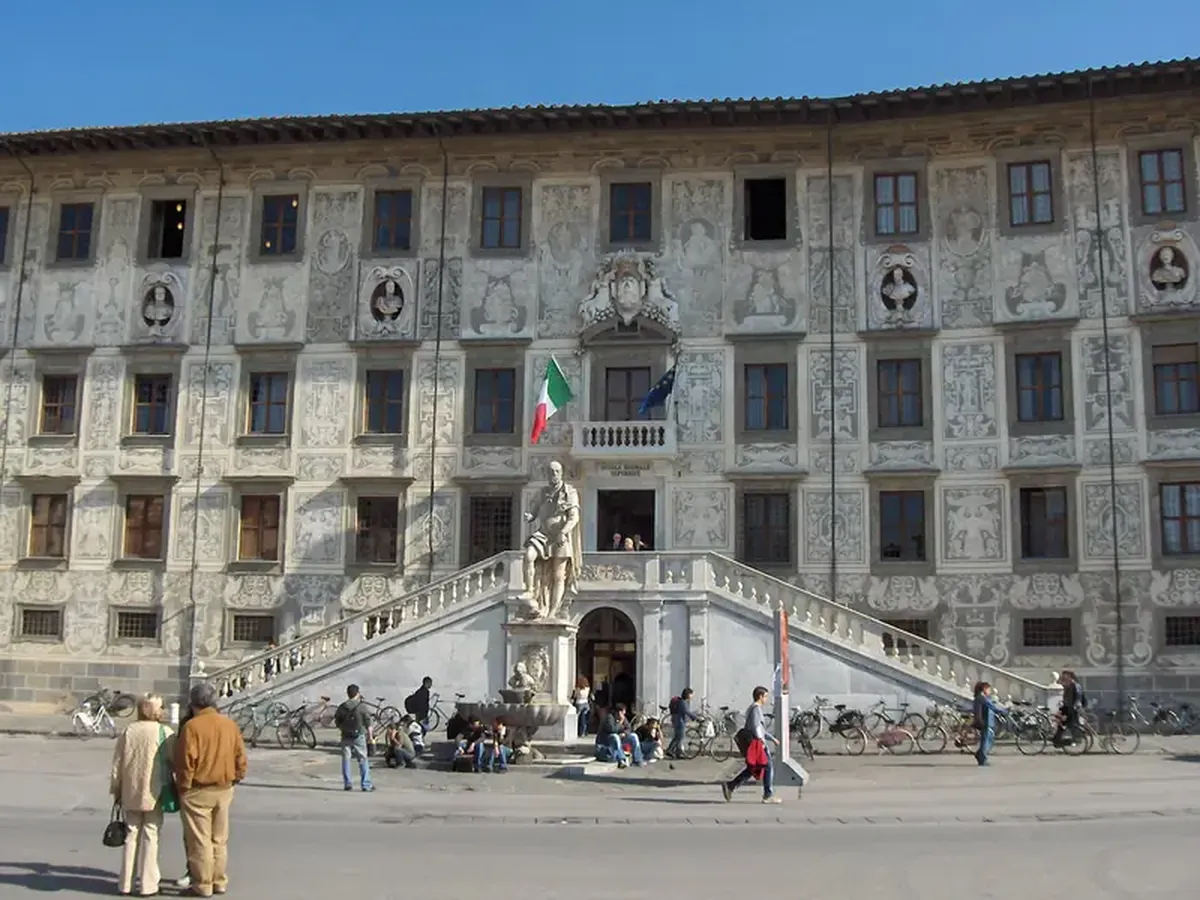
The Old Building of the University of Pisa
Family finances limited his studies: the money ran out after three years and Galileo left without a degree because the university would not waive tuition for him. A turning point came when he found a patron in Marquis Guidobaldo del Monte, whom Galileo praised as a genius on par with Archimedes. With the marquis’s support and the intervention of the Tuscan duke Ferdinand I de’ Medici, Galileo secured a paid position that helped launch his career.
In 1589 Galileo returned to the University of Pisa as a professor of mathematics. In his first year of independent research he wrote the treatise “On Motion.” After his father’s death he took responsibility for his siblings, which deepened his determination. In 1592 he moved to the University of Padua in the Venetian Republic as a lecturer in astronomy, mechanics, and mathematics; a recommendation from the Venetian Doge attested to his growing scientific reputation.
Challenging Traditions
Galileo’s years in Padua were his most productive. He won the respect of students and local authorities, who commissioned technical developments from him. The author of the treatise “Mechanics” corresponded with leading scientists of the day, including followers of Kepler. But in 1604 he received his first denunciation to the Inquisition, accused of reading forbidden books and of dabbling in astrology. The Padua inquisitor Cesare Lippi’s personal sympathy saved Galileo from early prosecution.

Galileo’s Last Work on the Foundations of Mechanics
Galileo kept following his interests. The appearance of Kepler’s Supernova in 1604 spurred a series of astronomy lectures, and when he learned that a telescope had been invented in Holland he built his own. With that instrument he resolved the stars of the Milky Way, observed sunspots, mapped the lunar surface, discovered Jupiter’s moons, and was the first to suggest the existence of rings around Saturn.
His telescopic observations astonished contemporaries; even a century later some skeptics called them illusions. After publishing his findings in the 1610 book “Starry Messenger,” Galileo received orders for his telescopes from European royalty and presented instruments to Venetian senators. They rewarded him with a lifetime professorship and a generous salary of 1,000 florins. He became a European sensation, compared by some to Columbus. Only a few — mainly astrologers and physicians — objected, arguing that the new discoveries threatened their methods.

Galileo’s Telescopes “cannocchiali” in the Galileo Museum in Florence
“Escalation of Heresy”
The turning point came in 1610 when Galileo left Venice, where the Inquisition was less active, to settle in Florence. Around that time his personal life changed: he formed a long-term relationship with a Venetian woman, Marina Gamba, and became the father of three children — Vincenzo (legitimized in 1619), Virginia, and Livia (the daughters later entered a convent). Needing funds to support his family, Galileo accepted a lucrative position at the Tuscan court promised by Duke Cosimo II de’ Medici; Cosimo fulfilled his promise, helping Galileo pay debts and provide dowries for his sisters. Galileo’s court duties were light: he taught the duke’s sons while formally remaining a professor of mathematics without regular lectures.
Continuing his research, Galileo discovered the phases of Venus and the rotation of the Sun. His bold, polemical style and his open defense of Copernicanism earned him enemies in academic circles and among the Jesuits. He promoted a heliocentric model that implied Earth’s motion — a conclusion some regarded as contradicting Scripture.

Galileo Shows the Telescope to the Venetian Doge (Fresco by Giuseppe Bertini, 1858)
At the height of his fame, in 1611 Galileo traveled to Rome to argue that Copernicanism did not contradict Catholic teaching. A commission of cardinals reviewed the use of the telescope and debated whether it was sinful to study the heavens through such an instrument. Encouraged by supportive voices, Galileo later asserted that Scripture addresses salvation and should not be used as the final authority on scientific questions: “No postulate of Scripture has such compelling force as natural phenomena.” In 1613 he published “Letters on Sunspots,” openly endorsing Copernican ideas.
Debating the Inquisition
In February 1615 the Roman Inquisition could no longer ignore Galileo’s views and opened the first formal case against him. The inquiry followed Galileo’s public challenge asking the Roman authorities to clarify their position on Copernicanism. That move prompted the Church to accuse him of heresy amid the anxieties of the Reformation, which had shaken Catholic leaders and made them wary of anything that might undermine their interpretive authority over Scripture. Theologians warned that treating Copernicanism as more than a mathematical model could be taken to mean that the Church’s traditional readings of the Bible were fallible.
After the Council of Trent, the Church prohibited interpretations of Scripture that contradicted the consensus of the Church Fathers and upheld the view that the Earth was immovable at the center of the world. By contrast, the claim that “the Sun stands immovably at the center of the world” was judged by Inquisition experts to be “a nonsensical thought, false from a philosophical standpoint and sinful from a religious perspective.” The official verdict of February 24, 1616, declared heliocentrism “a dangerous heresy” and forbidden until corrected; after the Pope’s approval, that decision carried legal force.

Galileo Before the Roman Inquisition, Cristiano Banti, 1857
The decree was unacceptable to Galileo, who continued to defend his views despite the ban. He tried to craft a neutral work presenting different arguments and spent 16 years preparing it. When his friend Matteo Barberini became Pope Urban VIII in 1623, Galileo hoped for relief and traveled to Rome to ask for repeal of the 1616 edict. Urban forbade Jesuits from debating Galileo for a time, but the dispute lingered. In the 1632 book “Dialogue,” Urban felt caricatured by one of the characters and took personal offense, which deepened the rift.
The Path to Truth
During the investigation Galileo was interrogated under threat of torture. On his knees he made a formal renunciation of the forbidden views, but he was still placed under house arrest for the rest of his life. The Inquisition did not engage him in scientific debate; their concerns were narrow: whether he had knowingly violated the 1616 edict and whether he had truly repented. He faced a stark choice: abjure the “dangerous errors” or suffer the fate of Giordano Bruno for refusing to recant.

Galileo in Prison, Jean Antoine Laurent
Galileo’s recantation spared him the stake, but it did not change his convictions. Under surveillance, he continued his scientific work even as his eyesight failed. He moved to Arcetri, near the convent where his daughters lived, and outlived both of them; his favorite daughter Virginia, who took the name Maria Celeste in the convent, died at 33. Galileo’s movements and communications were restricted, his printed works subject to censorship, and when he died on January 8, 1642, he was attended by two guards.
House arrest did not stop his influence. Galileo’s ideas on the uniformity of matter and motion laid groundwork for Newton’s later discoveries, and his banned “Dialogue” circulated in Latin translation in Protestant Holland. He even planned an anonymous defense of his views. Teaching kinematics and material resistance, he wrote that “even in darkness” he could not stop thinking about nature because his “restless mind” would not be stilled. He called his last book, “Discourse and Mathematical Proofs of Two New Sciences,” a refutation of Aristotelian dynamics that proposed experimentally tested principles of motion.

Half-blind Galileo on a walk with his daughter. Engraving from Gaston Tissandier’s book “Martyrs of Science”
The Church allowed Galileo to be buried without honors and placed him apart from the family basilica; his remains were reunited with his son’s only later. The family’s last representative, Galileo’s only grandson, became a monk and burned some of his grandfather’s manuscripts as blasphemous. Still, Galileo’s intellectual legacy endured: his ideas reached later generations even if acceptance came slowly. After a commission worked from 1981 to 1992, Pope John Paul II formally acknowledged the Church’s error regarding Galileo at the end of the 20th century.
